
2-2-3 Work Schedule: Meaning, Benefits & Examples
In a world that never pauses, businesses need schedules that keep operations running without burning out employees. The 2-2-3 work schedule offers a structured way to achieve that balance. Read on to find out how it works!


When a business runs day and night, scheduling becomes more than an administrative task. It directly affects productivity, employee well-being, and the ability to maintain reliable service.
That is why many organizations use the 2-2-3 work schedule. Also known as the Panama schedule, this working schedule follows a structured rotation of workdays and rest days that keeps operations running continuously while giving employees predictable multi-day breaks.
For managers and distributed teams, it brings greater clarity to scheduling, improves visibility into working hours, and helps reduce overtime disputes across rotating shifts.
Summary
- Understand what a 2-2-3 schedule means and how the rotation works.
- See real examples of the shift pattern and working hours.
- Learn which industries commonly use the Panama schedule.
- Compare operational advantages and workforce challenges.
- Follow practical steps for implementing the schedule.
- Discover how time-tracking tools help manage rotating shifts.
What is a 2-2-3 work schedule?
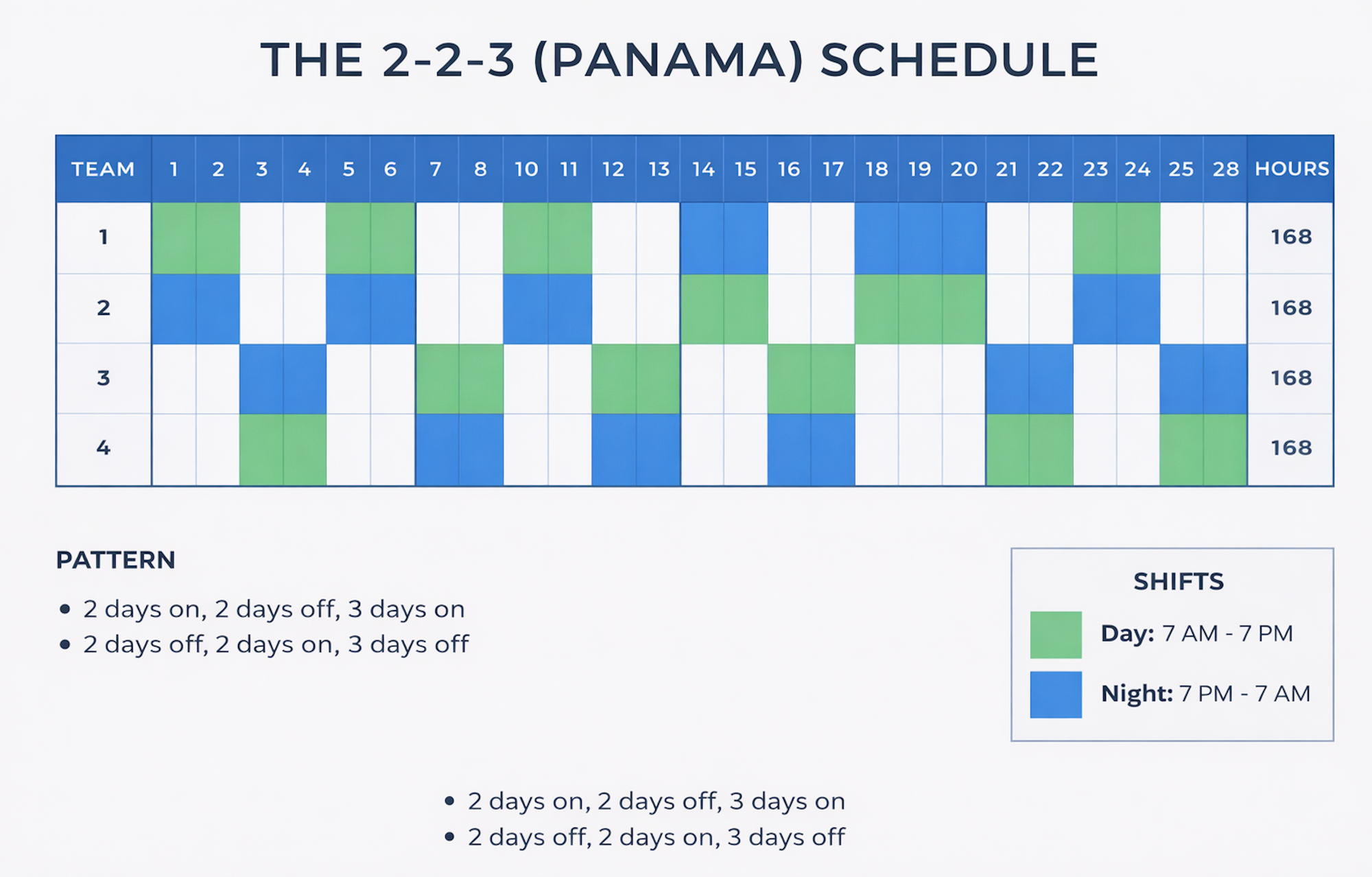
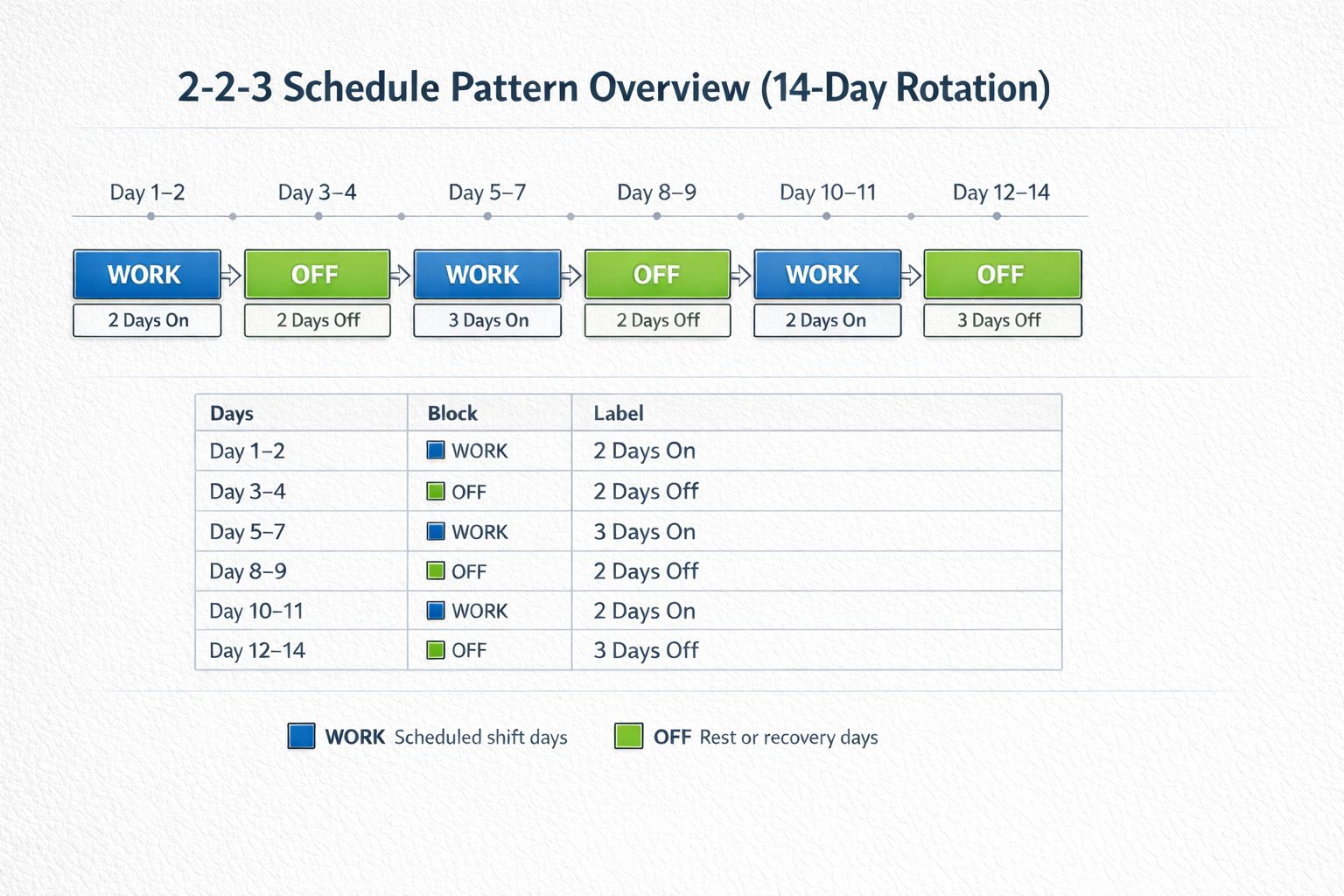
A 2-2-3 schedule is a rotating shift pattern where employees work two days, take two days off, then work three days before the pattern reverses the following week. The cycle repeats every 14 days, allowing organizations to maintain continuous staffing without relying on a traditional five-day workweek.
The schedule is commonly known as the Panama schedule and is widely used in industries that require uninterrupted operations, such as healthcare, manufacturing, energy, and emergency services. The structure distributes shifts across several teams so businesses can operate 24/7 while employees still receive regular recovery days.
The rotation follows a simple two-week pattern:
After the second week, the cycle repeats.
This structure means employees typically work three or four days per week, while organizations maintain consistent coverage across all shifts. In most implementations, each shift lasts 12 hours, allowing two shifts to cover the full 24-hour day.
Because there are fewer shift handovers compared with shorter shifts, the model can also improve operational continuity and reduce communication gaps between teams.
How does a 2-2-3 schedule work?
A rotating 2-2-3 schedule works by rotating multiple teams through the same two-week shift pattern, ensuring that some employees are always working while others are resting. Instead of assigning the schedule to a single worker, organizations apply the rotation across several teams so operations continue around the clock.
Most implementations divide employees into four teams. Two teams cover the day shift while two teams cover the night shift, and the teams rotate through the schedule so coverage remains balanced.
A simplified 2-2-3 work schedule example might look like this:
During the following week, the pattern reverses for each team. Over the full cycle, employees alternate between work periods and rest days while the organization maintains continuous staffing.
This structure keeps workloads balanced across teams and helps stabilize operations. Because employees never work more than three consecutive days, the schedule limits long fatigue stretches while still supporting full 24-hour coverage.
For industries that run continuously (such as hospitals, power plants, manufacturing facilities, and global support centers), the rotation provides a predictable way to staff every shift without requiring employees to follow a traditional five-day workweek.
What is a 2-2-3 rotating schedule?
A 2-2-3 rotating schedule means teams periodically switch between day and night shifts while following the same two-week pattern. This prevents one group from permanently carrying overnight work.
Teams often stay on one shift for two to four weeks before rotating. This gives employees time to adjust their sleep cycle before switching.
However, rotating shifts requires careful management. Research shows night shifts and long hours can raise workplace injury risk by 25–30% when fatigue is not properly controlled. Because of this, companies typically pair rotating schedules with strict rest and fatigue-management policies.
How many hours is a 2-2-3 schedule?
The number of hours worked on a 2-2-3 schedule depends on shift length, but most organizations implement it using 12-hour shifts. Because the schedule spreads shifts across a two-week cycle, employees typically work seven shifts every 14 days.
Hours in a two-week cycle
Hours in a four-week cycle
Over a full 28-day period, employees usually work about 15 shifts.
This equals roughly 1,800–1,820 working hours per year, which is close to the annual total for standard full-time employment.
Comparison with a typical office schedule
Although employees work fewer days, the longer shifts produce a similar monthly workload. Actual totals may vary depending on local overtime rules, pay periods, and whether organizations add additional “plus” shifts during busy periods.
2-2-3 Work schedule calendar
The 2-2-3 schedule is easiest to understand when viewed as a calendar grid. The pattern repeats across two weeks and shows exactly when employees work and rest.
Example 2-week rotation
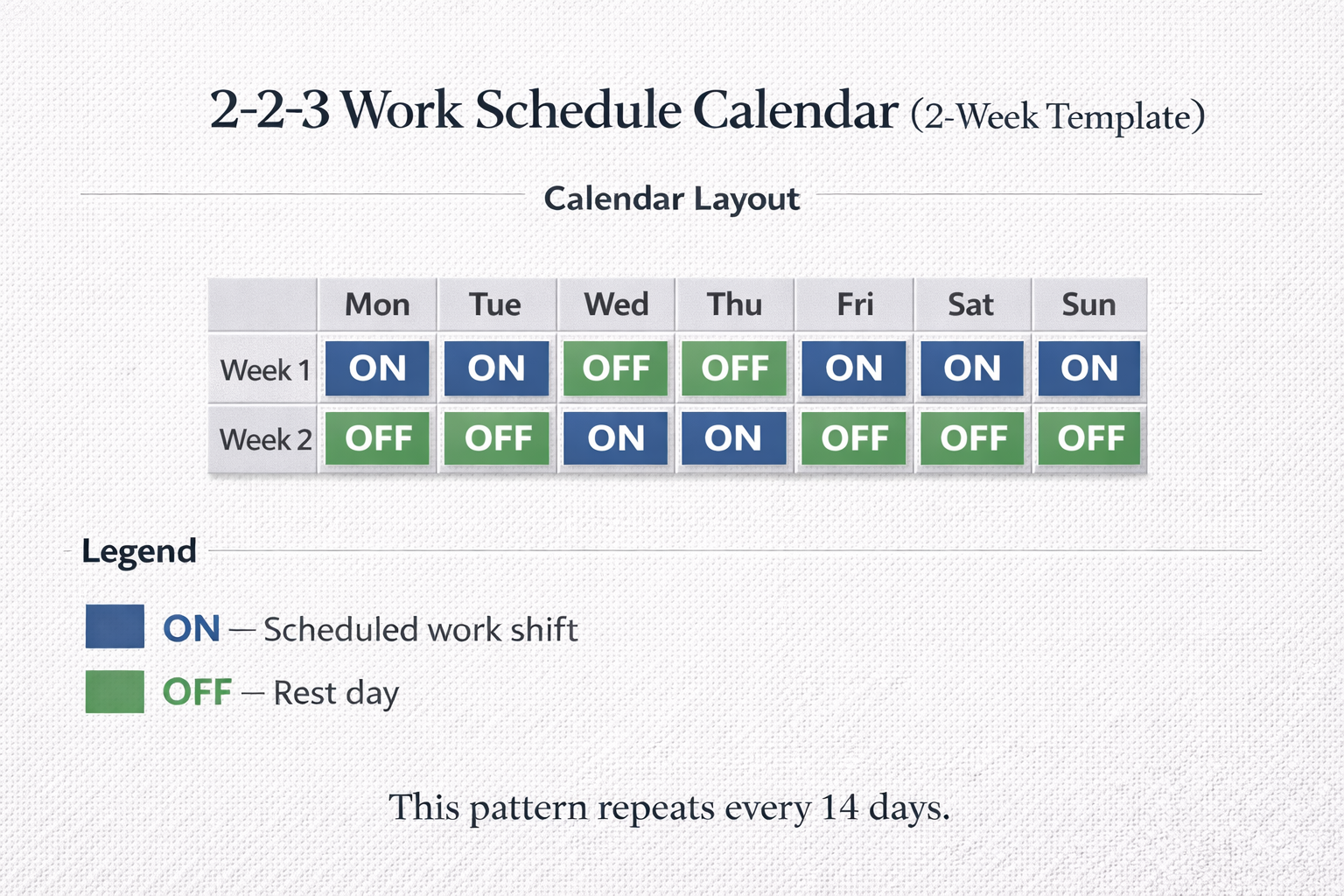
After the second week, the same pattern starts again.
How to read the calendar
- ON indicates scheduled workdays.
- OFF indicates rest days.
The pattern continues for future weeks.
One practical feature of the schedule is weekend rotation. Employees usually work every other weekend, followed by a longer break the next week.
Because the pattern is predictable, managers can plan staffing months. This consistency is one reason the schedule is widely used in operations that require reliable coverage, such as healthcare, manufacturing, and emergency services.
2-2-3 schedule for 24/7 coverage
The 2-2-3 schedule is widely used in organizations that require continuous operations. By rotating multiple teams through the same shift pattern, companies can maintain full coverage across all hours without requiring employees to work long consecutive stretches.
Most implementations rely on four teams working across two 12-hour shifts—one during the day and one overnight. As the teams rotate through the schedule, staffing remains balanced while employees cycle between workdays and rest days.
A typical coverage structure looks like this:
Over time, each team rotates through the same schedule, ensuring coverage remains consistent across both shifts.
This structure reduces operational gaps by limiting shift transitions and keeping staffing levels stable throughout the week. Industries that commonly rely on this model include:
- Hospitals and emergency services
- Manufacturing facilities
- Energy and utility operations
- Transportation networks
- Security and surveillance teams
- Global customer support centers
Because these sectors must operate during nights, weekends, and holidays, rotating shift systems like the 2-2-3 schedule provide a reliable way to maintain continuous coverage.
2-2-3 Work schedule pros and cons
The 2-2-3 schedule can improve operational coverage but also introduces challenges for employees and managers. Evaluating both sides helps organizations determine whether the model fits their staffing needs and workforce expectations.
2-2-3 Work schedule pros
One of the main advantages of the schedule is the balance between extended shifts and predictable recovery periods.
Key benefits include:
2-2-3 Work schedule cons
Despite these benefits, the model also presents several operational and human challenges.
Because of these challenges, organizations often combine rotating schedules with workforce management and time-tracking systems to maintain accurate schedules and minimize administrative errors.
How to implement a 2-2-3 work schedule step by step
Implementing a 2-2-3 work schedule requires careful planning so coverage, employee well-being, and payroll tracking all remain consistent. The following steps outline a practical approach for organizations introducing this rotation model.
When implemented carefully, the 2-2-3 schedule can create predictable staffing while giving employees regular recovery periods.
How TMetric helps teams run a 2-2-3 schedule
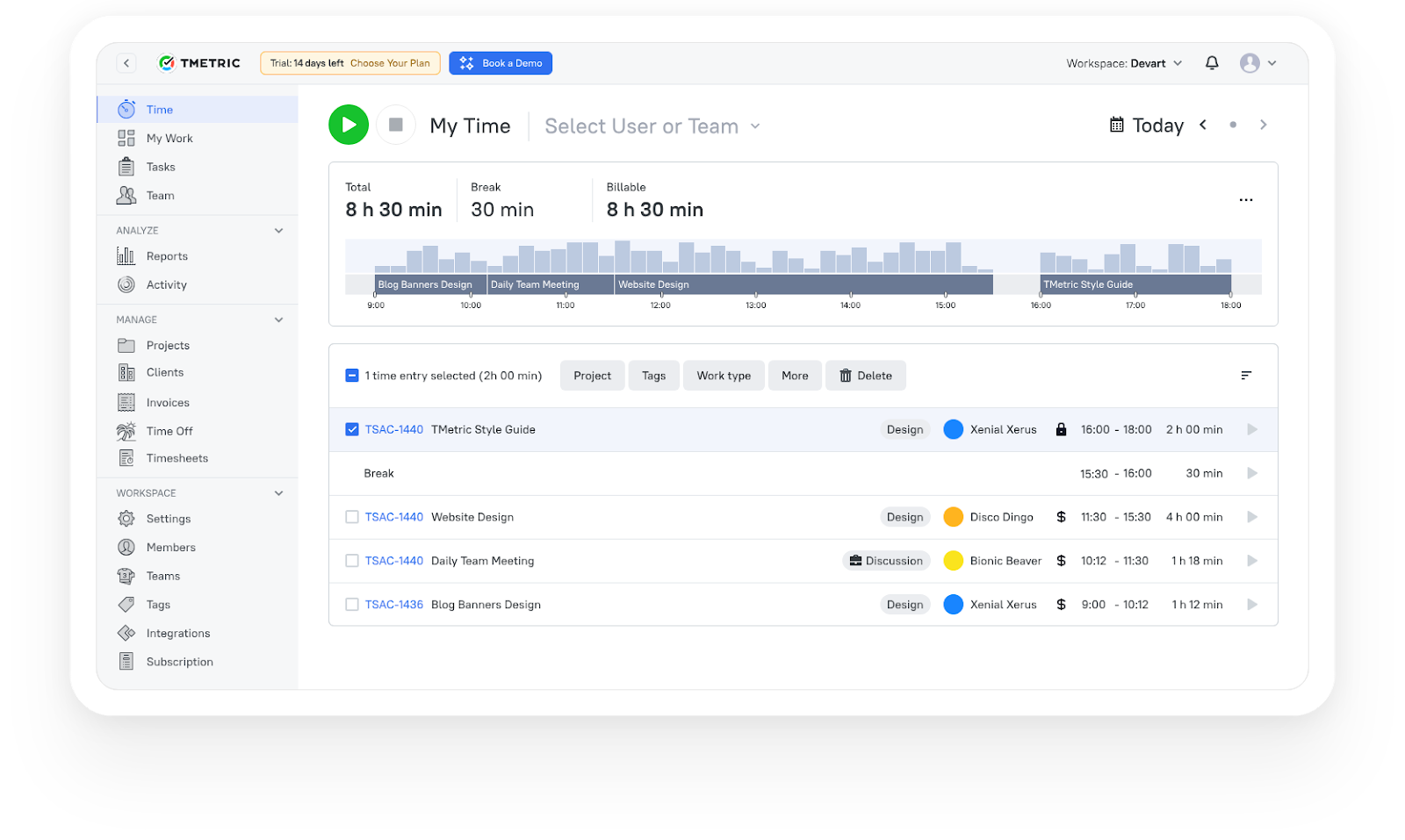
Managing a 2-2-3 schedule with spreadsheets or manual timesheets often leads to errors, overtime confusion, and limited visibility into how shifts are actually worked. TMetric helps teams track hours accurately and monitor workloads across rotating schedules.
- Employees can track time by project, client, or task, making it clear how work is distributed across shifts.
- Teams can log hours during both day and night rotations, ensuring every shift is recorded consistently.
- Managers can review weekly and monthly reports to see total hours worked across rotating teams.
- Supervisors can identify workload imbalances or overtime risks early, before they affect payroll or operations.
For organizations operating around the clock, these insights provide a clearer picture of how time is spent, even when schedules rotate every two weeks.
Try TMetric free to track hours, generate reliable timesheets, and maintain clear reports for teams working on rotating schedules.
The Takeaway
The 2-2-3 work schedule is a structured rotating system designed to support continuous operations while providing employees with predictable rest periods. By alternating two-day and three-day work blocks across a repeating cycle, the model ensures coverage while limiting long stretches of work.
It is widely used in healthcare, manufacturing, emergency services, and other industries that operate around the clock. The schedule can improve staffing efficiency and employee recovery time, but it also introduces challenges such as long shifts, fatigue management, and complex scheduling.
Organizations that adopt the model usually pair it with strong scheduling tools and time-tracking systems.
Try TMetric free to track hours, create timesheets, and generate reports that still make sense when your schedule rotates.
3,000+ companies, teams, and individuals worldwide use TMetric to track time, manage work, and bill with confidence.
FAQ
What does a 2-2-3 schedule mean?
The 2-2-3 schedule meaning refers to a rotating shift pattern where employees work two days, take two days off, then work three days before the pattern reverses the following week. This 2 on 2 off 3 on 3 off schedule creates a repeating two-week cycle that helps organizations maintain continuous staffing.
How many hours is a 2-2-3 schedule with 12-hour shifts?
A standard 2-2-3 schedule includes 7 shifts in a 14-day cycle. With 12-hour shifts, that equals 84 hours every two weeks or roughly 180 hours over a four-week period, which is similar to many full-time workloads.
Is a 2-2-3 schedule better than a standard 5-day workweek?
Whether it is better depends on the type of work. A 2 on 2 off 3 on 3 off schedule works well for industries that require 24/7 coverage because it distributes shifts across teams while still providing regular multi-day breaks.
What jobs usually use a 2-2-3 work schedule?
Industries that operate continuously commonly use the 2 on 2 off work schedule, including healthcare, manufacturing, energy and utilities, transportation operations, security services, and global customer support centers.
Can TMetric handle rotating shifts like a 2-2-3 work schedule?
Yes. TMetric allows teams to track time across rotating shifts and different projects, which helps organizations manage schedules like the 2-2-3 rotation more accurately.
Can TMetric help prevent overtime mistakes on 12-hour shifts?
TMetric provides detailed time tracking and reporting, allowing managers to monitor total hours worked and identify potential overtime issues before payroll is processed.