
7 Essential Time Management Skills You Need Today
Being busy is easy. Being effective is a skill. So why do some people always seem ahead while others are always catching up? The answer may be simpler, and more surprising than you think. Read on!


Modern work is not limited by effort; it is limited by attention and time. Despite longer workdays and constant digital connectivity, the average employee is productive for only about 2 hours and 53 minutes per day, while meetings, interruptions, and administrative coordination consume the rest of the time.
This productivity gap explains why time management skills have become one of the most valuable professional competencies. Companies need workers who can set priorities, meet deadlines, and focus on important tasks instead of always responding to requests. Research shows, again and again, that better time management leads to better job performance, health, and school success.
This guide explains what time management skills are, why they matter, and how to develop them to work more efficiently, reduce stress, and achieve long-term goals.
 Alla Chernets
What are time management skills?
The time management skills definition refers to the abilities that help people plan, prioritize, and control how they use their time to achieve specific goals. They determine what tasks deserve attention, when to work on them, and how long each activity should take.
In practice, these skills include prioritizing responsibilities, setting clear goals, scheduling work, and maintaining focus while limiting distractions. Together, they help individuals direct their energy toward tasks that deliver the greatest impact instead of reacting to constant demands throughout the day.
Time management skills are often confused with productivity tools, but the two are different. Calendars, task managers, or time-tracking apps simply support the process. The real capability lies in the habits and decision-making skills that determine how those tools are used.
Is time management a skill or a set of skills?
Time management is not a single skill. It is a cluster of related soft skills that work together to control how time is used.
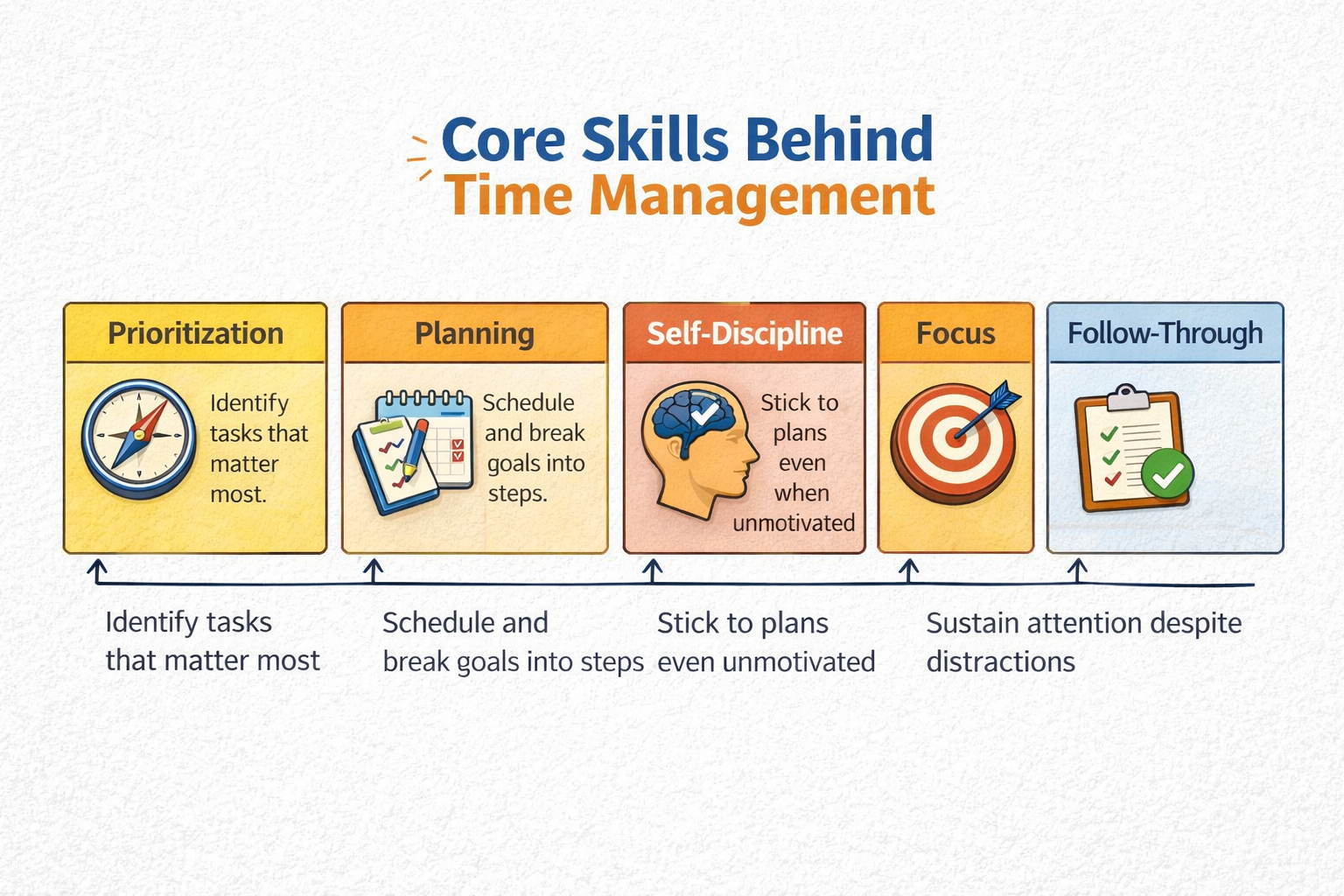
Time management is a set of skills that includes planning, controlling impulses, organizing, and making decisions. Studies indicate that personality characteristics, particularly conscientiousness, significantly influence an individual's time management efficacy.
Employers see time management as a key skill because it shows that a person has many different skills at once. A worker who is good at managing their time usually shows:
- Setting clear priorities
- Planning that works
- Discipline yourself
- Strong focus
- Consistent follow-through
These traits have a direct impact on how productive and reliable a team is.
For instance, a software developer who accurately estimates tasks and plans focused coding sessions will deliver features on time. A marketing manager who plans campaigns around quarterly goals makes sure that teams work toward measurable goals instead of just responding to requests every day.
Time management is best understood as a system of skills rather than a single ability because these behaviors involve many different mental processes, such as making decisions, controlling oneself, and organizing.


Why is time management important?
Managing your time well is important because it has a direct effect on how productive you are, how stressed you are, and how well you do at work. When people manage their time well, they get things done faster and don't have to worry about missing deadlines all the time.
Studies consistently validate these advantages of time management. A survey found that 94% of people think that better time management makes them more productive, and 91% think it makes them less stressed at work.
There are real effects of bad time management. According to research, workers spend more than half of their workday on tasks that don't add much value, like pointless meetings and coordinating emails.
Effective time management activities improve outcomes in several ways:
- Higher productivity: Planning and prioritizing tasks helps employees focus on high-impact work. Studies suggest that prioritization alone can increase productivity by 25% or more.
- Reduced stress and burnout: Workers who struggle to organize their tasks often experience anxiety and work overload. Time management reduces this pressure by creating structure and predictability.
- Better work-life balance: When professionals plan their work realistically, they can get things done on time instead of having to work late into the night and on weekends.
- Better job performance: Managers often think that people who are good at managing their time are also reliable and have the potential to be leaders. People who always meet deadlines are more likely to get promotions and more work to do.
For businesses, these benefits mean that their performance will get better in measurable ways. Companies that use structured time management methods say their productivity goes up by as much as 25%.
The 7 essential time management skills
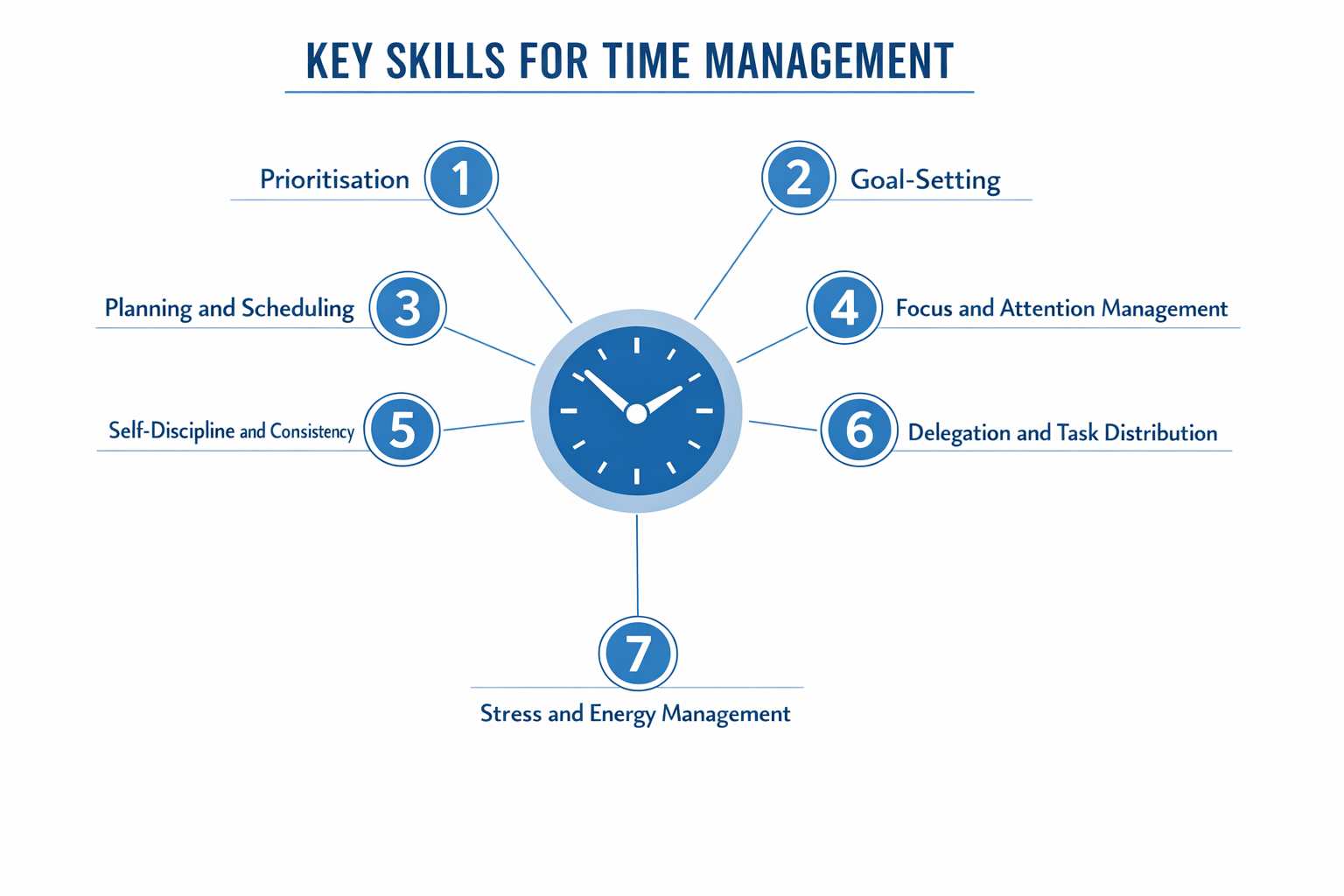
Effective time management strategies are built on a set of core skills. These abilities help professionals organize work, direct attention toward high-value tasks, and maintain consistent productivity even in demanding environments. Let’s explore them.
1. Prioritization
Prioritization is the skill of figuring out which tasks need to be done first and then giving them the time they need. Effective professionals don't treat every task the same. They know which tasks are urgent and which ones will add value in the long run.
For instance, a project manager who is dealing with a client escalation will take care of that problem before answering normal internal emails. Prioritization makes sure that important tasks are done before less important ones take up the whole day.
The Eisenhower Matrix is one of many time management tools that professionals use to help them make decisions by sorting tasks by how important and urgent they are.
2. Goal setting
Goal setting defines the outcomes that guide daily and long-term work. Without clear goals, tasks become reactive and disconnected from meaningful progress.
Effective goals include measurable targets and timelines. For instance, a marketing manager may set a quarterly objective to generate 5,000 qualified leads and align weekly campaigns, budgets, and reporting around that target.
Research suggests that writing down goals dramatically improves outcomes—people who record their goals are 42% more likely to achieve them than those who do not.
 Kate Hondarovska
3. Planning and scheduling
Planning turns goals into steps you can take, and scheduling puts those steps into time slots that make sense. They work together to turn plans into organized work.
Many professionals use calendars, project boards, or sprint planning systems to organize their work. For instance, in software development teams, tasks are usually broken down into two-week sprints, where roles are clearly defined and progress is checked every day.
Good planning helps teams plan ahead for deadlines instead of just reacting to them, which reduces cognitive overload.
4. Focus and Attention Control
Focus is the ability to stay focused on one thing even when there are other things going on. This skill is becoming more and more important in today's workplaces, which are full of emails, alerts, and meetings.
It takes about 23 minutes to fully get back on track after an interruption, which means that frequent distractions can make you much less productive. Many professionals use methods like time blocking or the Pomodoro Technique to help them focus better. The Pomodoro Technique breaks work into 25-minute focused intervals with short breaks in between.
5. Self-Discipline and Consistency
Self-discipline ensures that planned work actually gets done. Even the best schedules fail without the discipline to follow through when motivation fluctuates.
Consistency transforms short-term productivity tactics into sustainable habits. For example, a remote worker who starts work at the same time each day builds a predictable routine that supports focus and reliability. Over time, disciplined work patterns reduce procrastination and create steady productivity.
6. Delegation and Task Distribution
Delegation is the ability to assign tasks to others when appropriate. Many professionals struggle with this skill because they feel responsible for completing everything themselves.
Effective time management skills for managers allow leaders to focus on strategic work while empowering team members to contribute meaningfully. For instance, a team lead may delegate routine reporting to a junior analyst while concentrating on project planning and stakeholder communication. Organizations that delegate effectively increase efficiency and reduce managerial overload.
7. Stress and Energy Management
Managing time isn't just about making a list of things to do; it's also about managing your mental energy.
People who plan to work back-to-back without breaks often get tired of making decisions and their performance drops. People who do well at work plan their days so that they have breaks, focused work time, and time to relax.
For instance, a manager might plan short breaks between meetings or set aside mornings, when cognitive energy is highest, for making tough decisions. Keeping track of both time and energy helps you stay productive without getting burned out.
These seven skills are the basis for good time management, but their true value becomes clear when you use them in real-life work situations.
Time management skills examples in real life
The best time management skills become visible in the operational decisions professionals make throughout the workday. How meetings are structured, how deadlines are broken down, and how attention is allocated across competing priorities often determine whether teams move forward efficiently or drift into reactive work.
Meeting planning
In many organizations, meetings consume a large portion of the workweek. Research from Microsoft’s Work Trend Index suggests employees spend over 40% of their time in meetings and digital collaboration tools. Managers with strong time management skills counter this by structuring meetings around clear outcomes.
For example, a department leader may circulate an agenda in advance, limit the meeting to 30 minutes, and close with specific action owners and deadlines. This approach transforms meetings from open-ended conversations into focused decision-making sessions.
Control of deadlines
Most of the time, a complex project doesn't fail because of one missed deadline. It fails because progress isn't checked on soon enough, though. For example, a product designer who is adding a new mobile feature might break the work up into weekly goals, such as wireframes, usability testing, visual design, and development handoff.
Teams can find delays early and keep going instead of rushing at the end by keeping an eye on these smaller checkpoints.
Balancing the workload
Professionals who work on multiple projects often waste time switching between them. Research shows that switching tasks often can cut productivity by up to 40%. For example, consultants often handle more than one client account at a time. Instead of jumping from one task to another, experienced consultants set aside specific times in their calendars for each project.
 Marina Timchenko
This structured way of dividing attention lets you focus more deeply and makes sure that all of your responsibilities are moving forward.
These examples show a bigger truth: time management skills are rarely seen as separate skills. They show up in the daily habits of running a business that decide how work is planned, prioritized, and done.
These real-world scenarios show how time management operates in daily workflows. In professional environments, however, these skills also influence how employees are evaluated, trusted, and promoted.
Time management skills at the workplace
In the workplace, time management skills directly influence how employees are evaluated and trusted by their managers. During performance reviews, supervisors often look at practical indicators such as meeting deadlines, prioritizing tasks effectively, preparing for meetings, and completing work without constant reminders.
Time management also shapes how colleagues and leaders perceive reliability. Employees who plan their work clearly, communicate realistic timelines, and anticipate project dependencies help teams operate smoothly. When these skills are missing, delays and rushed work can disrupt coordination across departments.
Over time, strong time management becomes closely linked to career progression. Professionals who consistently deliver work on schedule and manage responsibilities independently are more likely to be trusted with larger projects, leadership opportunities, and promotions within the organization.
How to Improve Time Management Skills
Improving time management and organizational skills requires developing consistent habits that shape how work is planned and executed. Rather than relying on quick productivity tricks, professionals build stronger time management through structured reflection, prioritization, and regular adjustment of their workflow.
1. Conduct a time audit
Start by tracking how time is actually spent during a typical week. Many professionals are surprised to discover how much time disappears into meetings, emails, and task switching. A time audit reveals where productivity is lost and highlights opportunities to restructure the workday.
2. Identify priorities
Not all tasks contribute equally to meaningful outcomes. Clarifying which responsibilities deliver the greatest value helps professionals focus attention on work that moves projects forward rather than reacting to every request.
3. Implement structured planning
Once priorities are clear, tasks should be scheduled realistically. Calendars, project boards, and sprint planning systems help allocate dedicated time blocks for important work and prevent schedules from becoming overloaded.
4. Build consistent routines
Time management improves when work follows predictable rhythms. Starting work at consistent times, blocking focus periods, and reducing unnecessary interruptions create the stability required for sustained productivity.
5. Review progress regularly
Effective time management requires continuous adjustment. Weekly reviews allow professionals to identify delays, refine schedules, and improve how future work is planned.
Technology can also support this process by making time use more visible and measurable. For example, using time management software such as TMetric allows professionals to track work hours, understand how time is distributed across projects, and identify productivity patterns that may otherwise go unnoticed. Instead of relying on assumptions about where time goes, teams gain clear data that helps them refine schedules and allocate effort more effectively.
For distributed and remote teams, visibility becomes even more important. Exploring the best time management software can help organizations track workloads, coordinate deadlines, and maintain transparency across projects when colleagues are working across locations and time zones.
For a deeper look at practical methods professionals use to strengthen time management skills, you can also explore this guide, which outlines simple techniques for improving planning, focus, and daily workflow habits.
Over to you
Effective time management skills are developed through deliberate habits, not quick productivity tricks. As workloads grow and responsibilities expand, professionals must continuously refine how they prioritize tasks, structure their schedules, and allocate attention.
The individuals who manage time well treat it as a strategic resource. They regularly review priorities, protect focused work time, and remove activities that do not contribute to meaningful outcomes.
Over time, these practices compound. Work becomes more predictable, deadlines easier to manage, and decisions clearer because attention is directed toward the tasks that matter most.
Ultimately, mastering time management is not about doing more work; it is about consistently investing time where it produces the greatest impact.
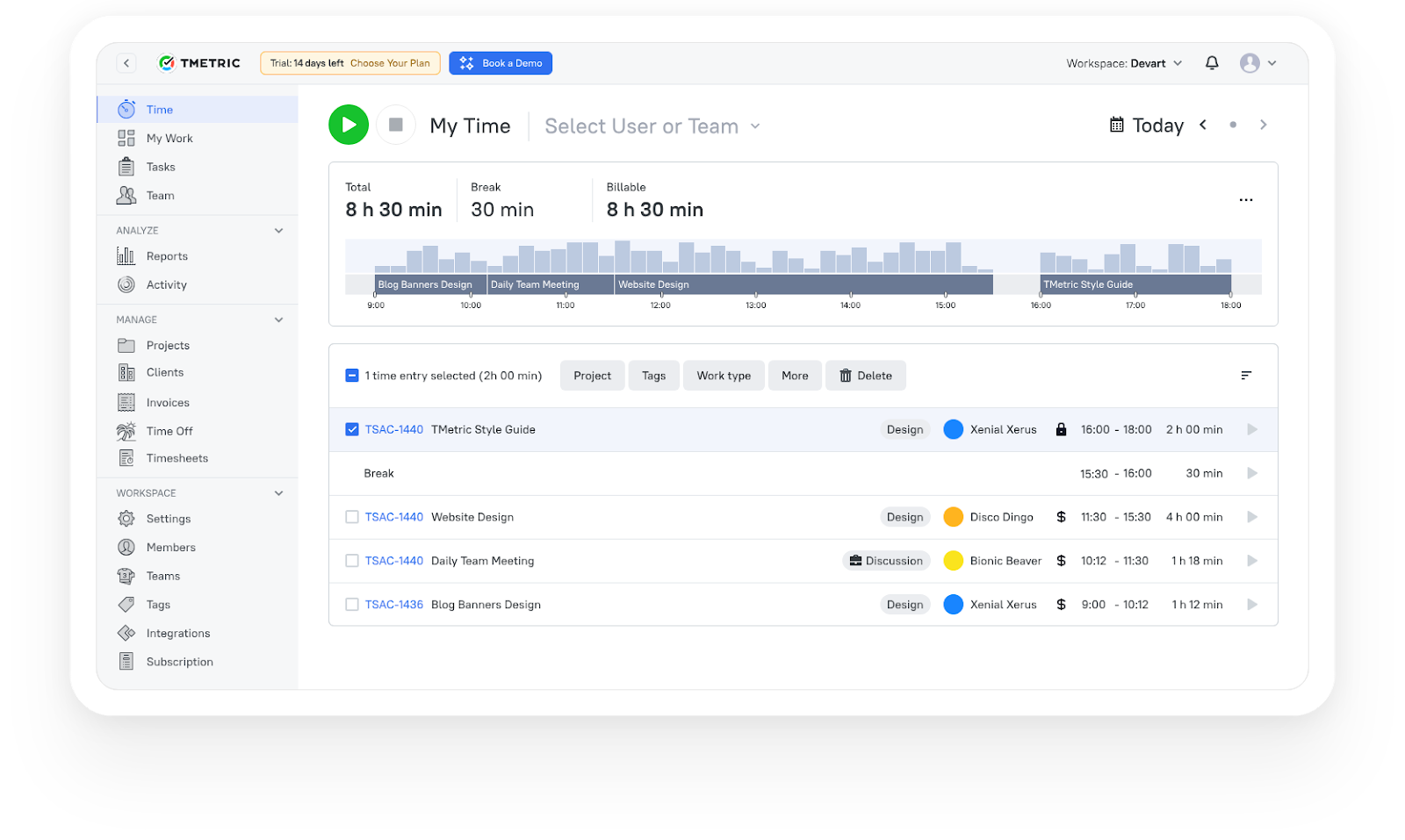
3,000+ companies, teams, and individuals worldwide use TMetric to track time, manage work, and bill with confidence.
FAQ
What are time management skills? Can you define time management skills clearly?
Time management skills are the abilities used to plan, prioritize, and organize tasks so that time is used efficiently and goals are achieved. If you define time management skills, they include practices such as prioritization, goal setting, scheduling, and focus management that help individuals control how their time is allocated.
Is time management a soft skill, and why is it important in the workplace?
Yes. Time management is considered a soft skill because it relies on behavioral abilities such as organization, decision-making, and self-discipline rather than technical expertise. Strong time management skills at workplace environments help employees meet deadlines, manage competing priorities, and maintain reliable performance across projects.
What are examples of good time management skills?
Time management skills include prioritizing tasks, planning schedules, maintaining focus, setting goals, and reviewing progress regularly. These abilities represent the core elements of time management that allow professionals to organize work effectively and deliver consistent results.
How can you explain time management skills simply?
If you need to know how to explain time management skills, the simplest way is to describe them as the ability to control how time is spent on tasks and responsibilities. These time and self-management skills help individuals decide what work matters most, schedule it effectively, and maintain focus until it is completed.
What are examples of time management skills at work?
Common examples of time management skills at work include prioritizing urgent tasks, planning daily schedules, setting clear deadlines, delegating responsibilities, and minimizing distractions during focused work periods. These practices help professionals maintain productivity and deliver projects on time.
Why are time management skills considered important life skills?
Many experts consider life skills time management essential because the ability to plan and organize time affects both professional success and personal well-being. Effective time management helps individuals balance work responsibilities, personal goals, and daily commitments without becoming overwhelmed.