
Project Cost Estimation: Techniques, Tools, and Key Steps
Nothing kills stakeholder confidence than a budget that keeps moving. This article will help you avoid that drama. Most overruns can be prevented with a clearer scope, smarter risk buffers, and better visibility into actual labor costs. Read on!


Project cost estimation is a step many project managers rush or underestimate, and the impact shows in the numbers. Studies covering 70 years of global projects found that 85% run over budget, with costs averaging 28% higher than the original estimate. The main reasons are unclear project scope, missing risk buffers, and estimates based on guesses instead of careful planning.
The good news: this is a solvable problem. Structured project cost estimation, built on proven techniques and real data, gives teams the financial visibility to deliver on time and on budget.
This guide explains how cost estimation in project management works, the five most reliable estimation techniques, a step-by-step process for building estimates, a practical example, and the tools that help remove guesswork.
Summary
- Know what cost estimation is and why it determines project success.
- Choose the right technique using clear accuracy trade-offs.
- Build defensible estimates with a proven five-step process.
- Apply a real worked example to your own projects.
- Replace budget guesswork with TMetric's real-time tracking.
What is project cost estimation in project management?
Project cost estimation is the process of figuring out how much money a project will actually need to finish. Teams review the scope, timeline, labor, tools, and materials, then build a realistic forecast of the total cost.
It’s easy to confuse estimation with budgeting, but they are not the same thing. Estimation comes first. A project cost estimate is an informed forecast based on available data. A budget, on the other hand, is the approved amount of money allocated to the project. When teams skip this distinction and lock in budgets too early, they often end up revising numbers later.
Cost estimates also change as a project moves forward. Early estimates—often called rough-order-of-magnitude (ROM) estimates—can be off by as much as ±50%. As the project becomes clearer and planning improves, those estimates usually tighten and may reach around ±10% accuracy.
Behind all of this sits a basic principle known as the project management iron triangle: scope, time, and cost are closely connected. When one changes, the others usually shift too. If one changes, the others must shift as well. A reliable cost estimate only works when the scope is clear and the timeline is realistic. Otherwise, the numbers are just optimistic guesses.
 Victoria Avdieieva
Why accurate project cost estimation matters
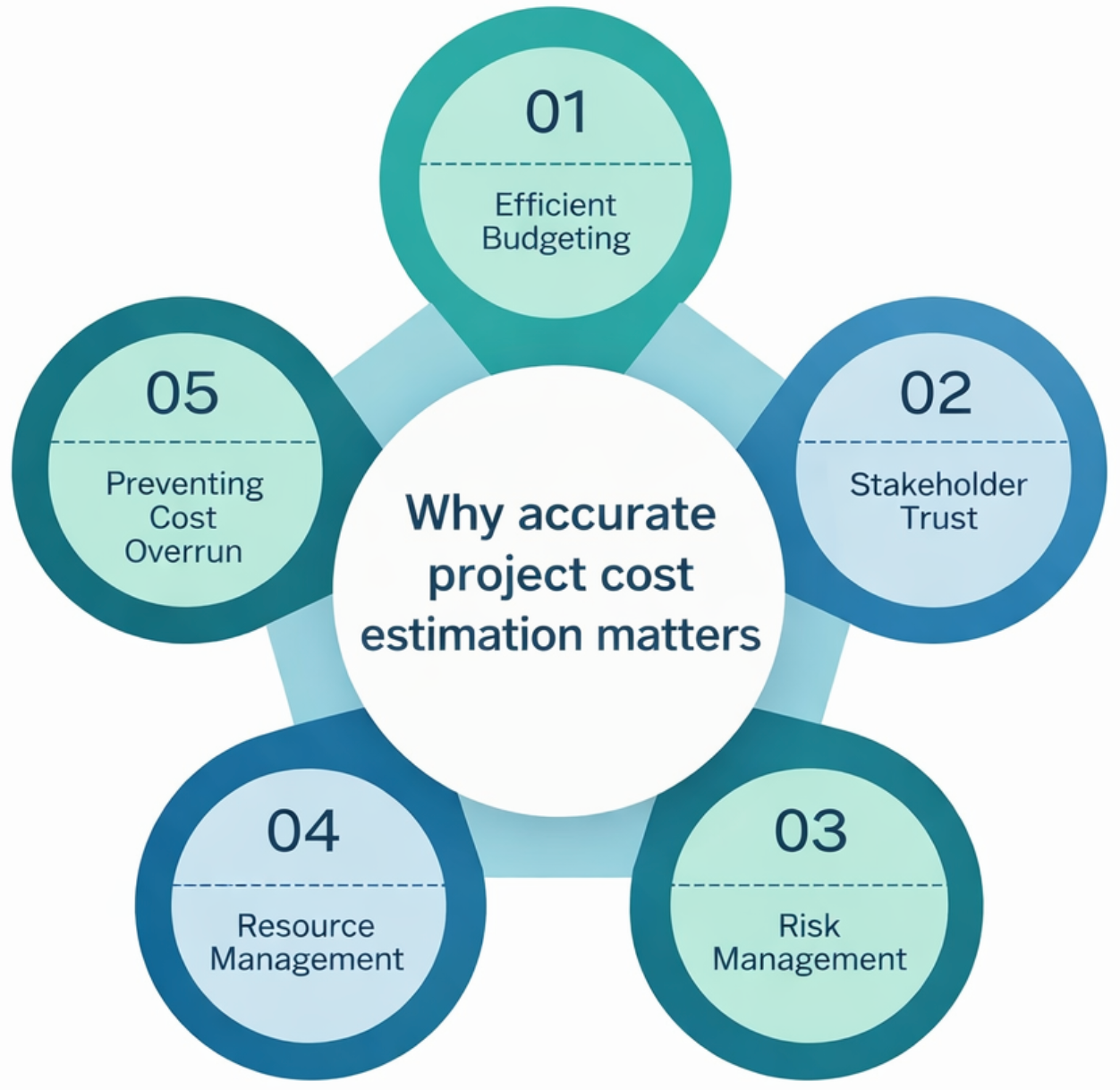
Poor estimates don’t just affect the budget. They can weaken stakeholder confidence, delay timelines, and push teams into reactive decisions later in the project. A study of 99 public building projects found that 58% ran over budget, 78% ran behind schedule, and nearly half experienced both. Often, this happens because estimation is treated as a quick formality instead of a careful planning step.
Accurate project management cost estimation changes that dynamic. It delivers:
- Higher funding approval rates: credible numbers move faster through sign-off.
- Better resource alignment: the right people and tools secured before work begins.
- A shared financial baseline: a number that leadership, clients, and teams work from.
- Earlier risk detection: scope creep caught before deficits deepen.
- Transparent cost communication: no surprises at delivery, only informed decisions throughout.
Projects that invest in rigorous estimation consistently outperform those that treat it as a box to check.
Key components of a project cost estimate
Project cost estimates need to account for both obvious expenses and the quieter costs that often get missed. Most estimates include six core elements:
- Labor costs: Usually the biggest expense. Calculated from hours worked per role multiplied by hourly rates.
- Materials and equipment: Physical resources needed to deliver the project, from hardware to rented equipment.
- Software and tools: Licenses, subscriptions, and platforms used during execution.
- Overhead and indirect costs: Admin support, infrastructure, and shared services that still consume resources.
- Contingency reserves: Typically, 10–15% of the estimate to cover known risks.
- Risk allowances: Extra provision for potential issues that are possible but not yet fully defined.
One common mistake in project cost estimation is ignoring indirect costs. Infrastructure use, compliance requirements, and project management time often push the final cost higher if they are not included early.
 Dmytro Sidenko
Project cost estimation techniques explained
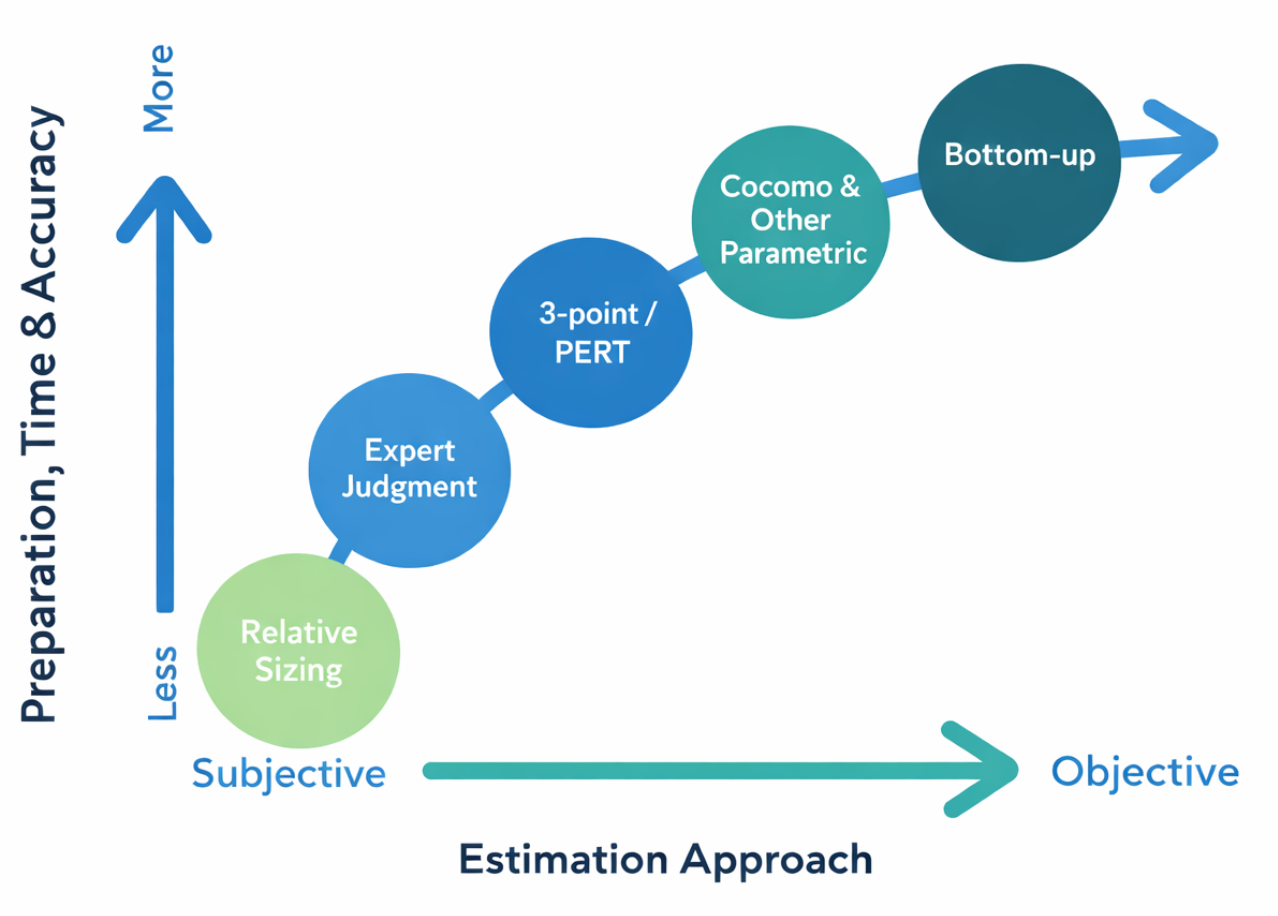
The cost estimation technique you choose affects how accurate and defensible the final estimate will be. No single method works for every project. The right approach depends on how much project detail is available, how much time you have to estimate, and the level of accuracy stakeholders expect at that stage. Let’s explore the techniques.
Analogous estimating
Analogous estimating uses information from similar past projects to produce a quick, high-level project cost estimate. It’s often used early in planning when project details are still limited, and stakeholders just need a rough number to judge whether the project is worth moving forward.
The downside is accuracy. These estimates usually fall within a ±30–50% range. That’s fine for an early feasibility check, but not reliable enough for a final project budget. The method works best when the past project used as a reference is very similar in scope, technology, and team setup. Comparing a software project to a hardware project, for example, rarely produces a meaningful estimate.
Parametric estimating
Parametric estimating uses statistical relationships and cost-per-unit calculations to build a project cost estimate. Instead of relying on general similarity, it works with measurable variables such as cost per hour, cost per square foot, or cost per function point, using historical data to scale the estimate.
This method can deliver fairly strong accuracy when the data behind it is reliable and the project variables are clearly defined. It usually takes more preparation than analogous estimating, but far less effort than a full bottom-up estimate, which makes it a useful middle ground between rough estimates and detailed planning.
Bottom-up estimating
Bottom-up estimating works by calculating costs for individual tasks or work packages and then adding them together to form the total project cost estimate. It’s generally the most accurate method, but it also takes the most time because the project first needs a detailed Work Breakdown Structure.
Since the delivery team is involved in estimating each task, this approach often reveals cost factors that top-down estimates miss. However, there’s also a risk: teams may lean toward optimistic assumptions unless those estimates are carefully reviewed and challenged.
Three-point estimating (PERT)
Three-point estimating reduces uncertainty by defining three cost scenarios:
- Optimistic (O)
- Pessimistic (P)
- Most likely (M)
The PERT formula, (O + 4M + P) ÷ 6, produces a weighted average that assigns four times more weight to the most likely outcome, generating a defensible range rather than a single fragile number.
This technique is especially valuable in high-risk or ambiguous environments where a point estimate would conceal dangerous variability. The discipline of building three independent scenarios forces teams to explicitly confront what could go wrong and price it in before the project begins, rather than discovering it mid-execution.
Expert Judgment
Expert judgment relies on the experience of people who have delivered similar projects before. When historical data is limited, unclear, or missing, their input can help fill the gaps that models or formulas cannot handle on their own.
That said, expert judgment shouldn’t be treated as a shortcut. It works best when several experienced professionals provide their input independently, explain their assumptions, and compare their estimates openly instead of simply averaging them. When used together with other estimation techniques, it can make cost estimates more reliable.
Technique comparison
| Technique | Accuracy level |
Data requirement |
Best use case |
Time to prepare |
Risk sensitivity |
| Analogous Estimating | Low–Medium | Limited historical data from similar projects | Early-stage planning with minimal project details | Very fast | Low |
| Parametric Estimating | Medium–High | Reliable historical metrics and cost-per-unit data | Projects with measurable, repeatable components | Moderate | Medium |
| Bottom-Up Estimating | High | Detailed task-level breakdown and resource data | Complex projects requiring precise cost estimates | Time-Intensive | Medium–High |
| Three-Point Estimating (PERT) | Medium–High | Scenario-based inputs (optimistic, pessimistic, most likely) | Projects with uncertainty and variable conditions | Moderate | High |
| Expert Judgment | Variable | Access to experienced professionals | When historical data is limited or ambiguous | Fast–Moderate | Medium |
Step-by-step guide: How to estimate project cost
Accurate project cost estimation follows a structured, repeatable process, not a round of educated guesses. Estimating project costs without a defined methodology produces figures that crumble under scrutiny and become liabilities when conditions shift mid-delivery.
The five steps below describe a practical approach that scales from a two-week sprint to a multi-year program.
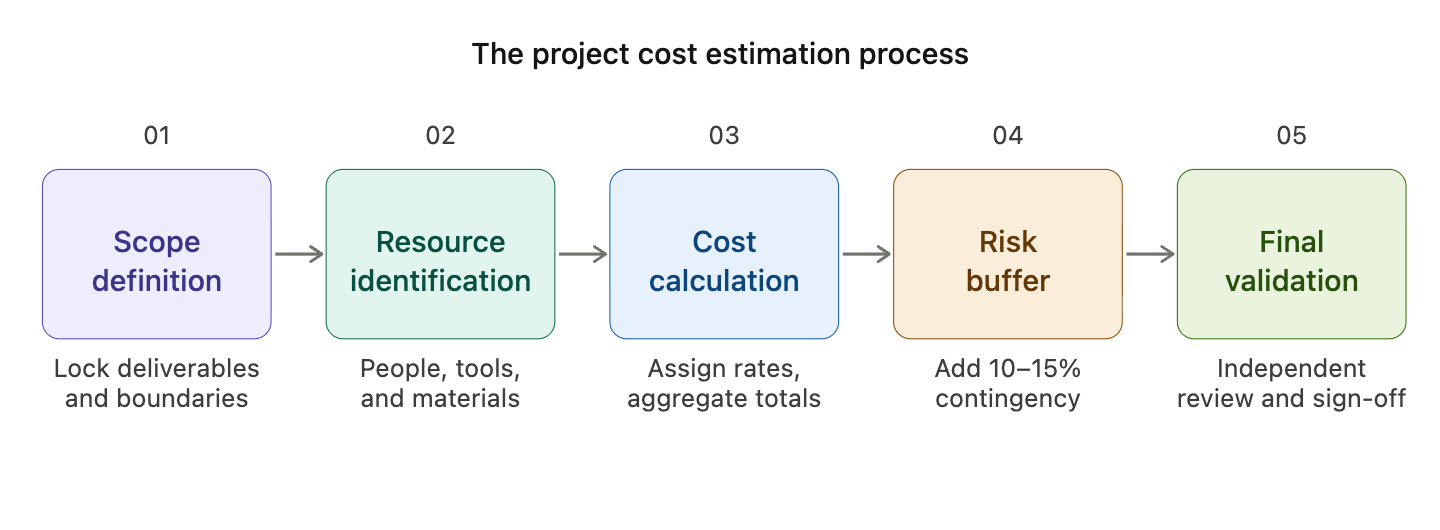
Step 1: Define the project scope
Start by clearly outlining deliverables, boundaries, assumptions, and exclusions. If the scope is vague, the estimate will be weak too.
Step 2: Identify the resources needed
List everything the project will require, including people, tools, software, materials, and infrastructure. Missing resources usually mean missing costs.
Step 3: Estimate the cost of each resource
Assign realistic costs using market rates, vendor quotes, or past project data. This is where the actual estimate starts taking shape.
Step 4: Add contingency and risk buffers
Include a contingency reserve, usually 10–15%, to cover expected uncertainty. Add extra risk allowance if the project has known but unquantified risks.
Step 5: Review and validate the estimate
Check the estimate against the scope, timeline, and assumptions. If possible, compare it with another estimation method or have someone else review it before finalizing.
Project cost estimation example (practical breakdown)
The easiest way to understand how to estimate project cost is to walk through a simple scenario.
Project cost estimate example
Consider a 10-week website redesign for a mid-size business that includes eight pages, custom design, CMS integration, SEO optimization, and full QA testing.
| Resource | Hours | Rate | Cost |
| Project Manager | 40 | $75/hr | $3,000 |
| Designer | 60 | $65/hr | $3,900 |
| Developer | 120 | $85/hr | $10,200 |
| QA Engineer | 30 | $55/hr | $1,650 |
Labor subtotal: $18,750
Additional project costs
| Cost category | Amount |
| Technology (CMS license + hosting setup) | $800 |
| Overhead (15% of labor) | $2,933 |
| Subtotal | $22,483 |
| Contingency (10%) | $2,248 |
Total project cost estimate: $24,731
This example illustrates the basic logic behind project cost estimation: identify resources, assign realistic rates, apply overhead, and include a contingency reserve. The result is a transparent calculation that stakeholders can easily review and adjust if assumptions change.
Tools that improve project cost estimation accuracy
Estimating costs with spreadsheets alone leaves too much room for guesswork. Modern project management platforms combine task tracking, time logs, and budget monitoring, giving teams real data from past projects to improve future estimates. Some widely used tools that support more accurate cost estimation include:
- TMetric: An integrated task manager with time tracking that helps teams compare estimated vs. actual labor costs.
- Jira: Common in software teams, with detailed task tracking and integrations that support budget and workload forecasting.
- Asana: Provides project timelines, workload views, and reporting that help teams monitor progress against estimated effort.
- Monday.com: Offers customizable dashboards and budget tracking features that make it easier to monitor project spending.
How TMetric helps with project cost estimation and budget control
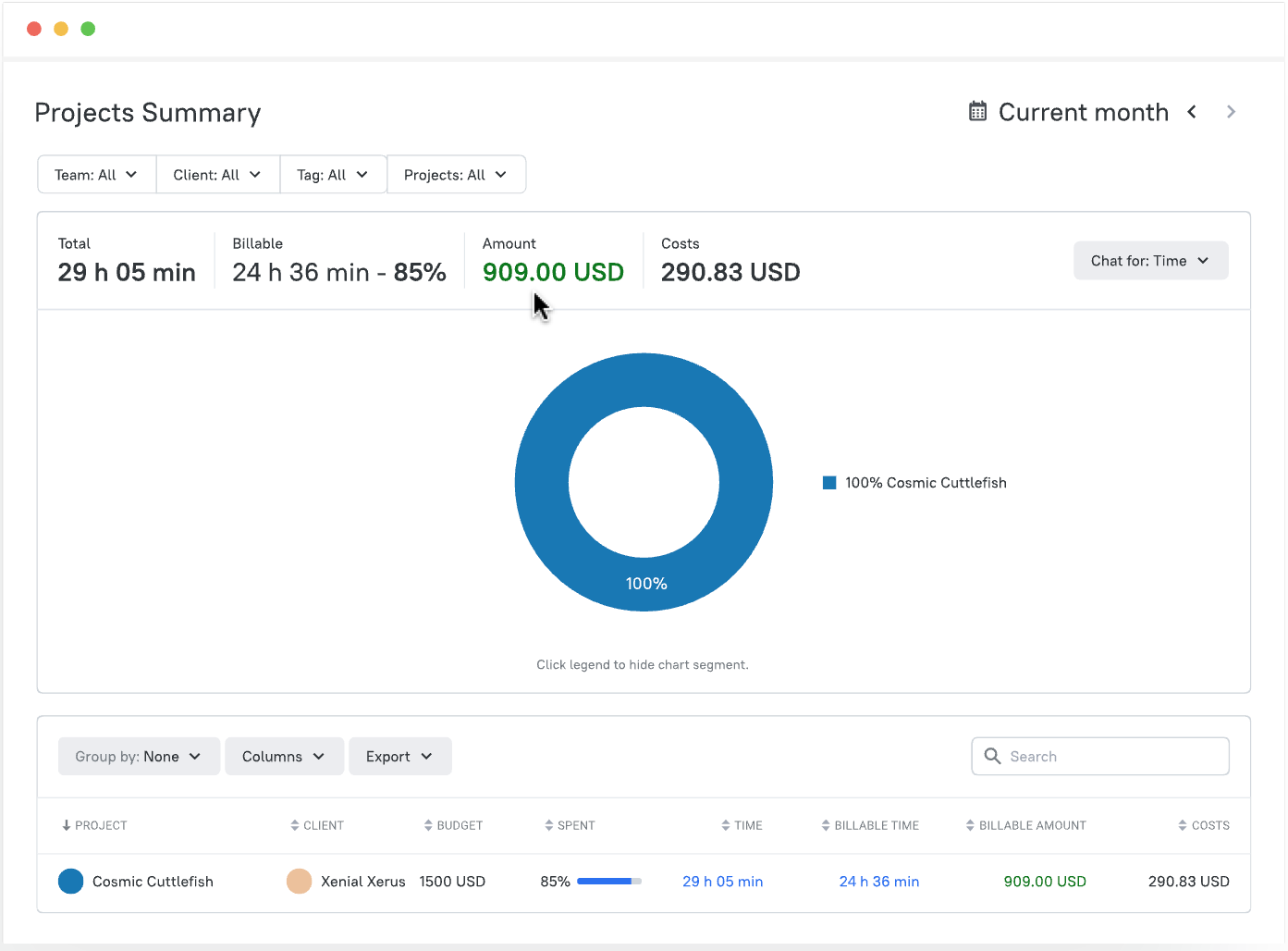
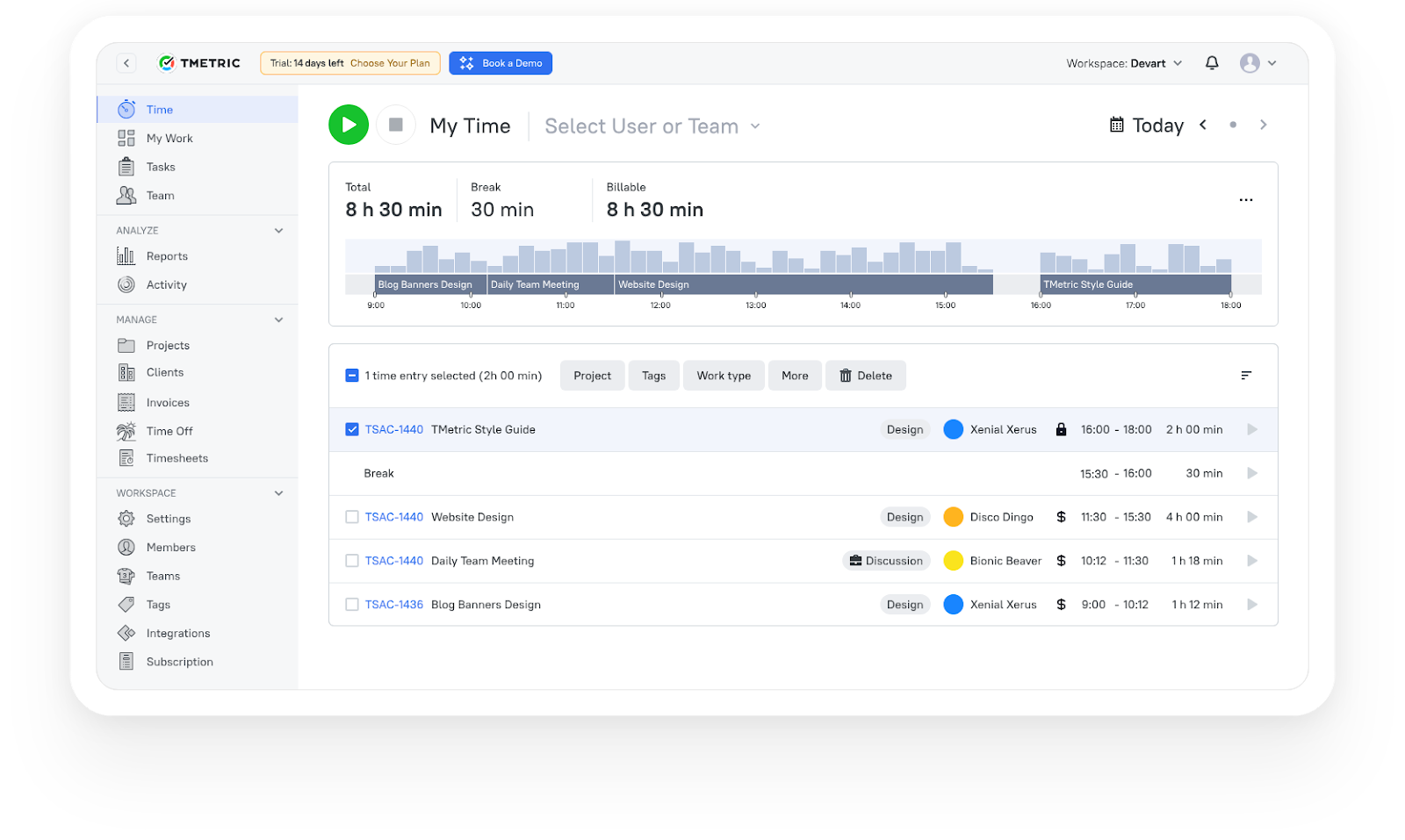
Accurate cost estimation depends on one thing most teams lack: reliable data about how long work actually takes. TMetric helps solve this by tracking time at the task and project level, turning day-to-day execution data into a practical reference for future estimates.
Key capabilities include:
- Time tracking by task and project.
- Historical reports that help analyze past project efforts.
- Project budget tracking with spending monitoring.
- Alerts when project costs approach the budget limit.
- Reports comparing estimated and actual project time.
- Billing and invoicing generated from tracked hours.
For teams using time tracking software to manage client billing, the benefit extends beyond estimation. Accurate time records support defensible invoices, reduce disputes, and gradually build the historical dataset that improves every future project cost estimate.
A free time card calculator can also be useful during early planning, helping teams quickly estimate labor costs for individual team members before building a full project budget.
Ready to replace assumptions with data? Start a free trial of TMetric and take the guesswork out of project cost estimating for good.
The Takeaway
Structured project cost estimation is what helps projects stay on budget instead of drifting into overruns. When teams apply the right cost estimation techniques in project management, they move away from guesswork and rely on realistic forecasts that stakeholders can actually trust.
Learning how to calculate project cost at the task level, adding risk buffers, and reviewing estimates before approval are habits that get better with experience. Each project tracked properly adds useful data, making the next estimate easier and more accurate. Tools like TMetric help teams build that history and turn project cost estimating into a consistent, repeatable process.
Try TMetric to start building the historical record that turns project cost estimating from a liability into a repeatable advantage.
3,000+ companies, teams, and individuals worldwide use TMetric to track time, manage work, and bill with confidence.
FAQ
How do I estimate project cost accurately at the planning stage?
Start by defining the project scope as clearly as possible and listing the resources needed. Assign realistic costs to those resources and add a contingency reserve for uncertainty. Using historical data from similar projects can also improve the reliability of your estimate.
What are the most reliable project cost estimation techniques?
Bottom-up estimating and three-point (PERT) estimating are usually the most accurate because they look at tasks and risk more closely. When details are still limited in early planning, analogous estimating can provide a quick, rough estimate.
What is the difference between a project cost estimate and a budget estimate?
A project cost estimate is a forecast of how much the project is likely to cost. A budget estimate in project management is the approved amount of money allocated based on that forecast.
What are common mistakes in project cost estimating?
Typical mistakes include leaving out indirect costs, skipping contingency reserves, estimating before the scope is clear, or relying on only one estimation method.
How often should cost estimates in project management be updated?
Cost estimates should be reviewed at key project stages and updated whenever the scope or schedule changes significantly.
Can TMetric help calculate project cost using real tracked hours?
Yes. TMetric uses tracked time and billing rates to estimate project costs and compare planned spending with actual project expenses.