
Best Productivity Improvement Techniques to Increase Performance
Why do some teams consistently outperform others without working harder? The answer often comes down to systems. Explore the productivity methods that help top performers focus better, work smarter, and achieve more.


Most professionals do not have a time problem; they have a focus problem. According to a global workplace study by Gallup, low employee engagement costs the global economy $8.8 trillion in lost productivity, which is equivalent to roughly 9% of global GDP.
Closer to the individual level, research by Dr. Gloria Mark at UC Irvine shows that a single workplace interruption costs workers an average of 23 minutes and 15 seconds of deep focus recovery time. Because most people are interrupted multiple times per hour, implementing structured productivity improvement techniques is essential to protect attention, cut wasted effort, and turn chaotic workdays into predictable output.
For modern organizations, improving productivity serves as a direct driver of profitability and long-term competitiveness. This article covers the most effective methods, how to apply them, and how to build them into a business-wide strategy that actually sticks.
What is productivity improvement and why it matters
Productivity improvement is the systematic process of optimizing how inputs (time, energy, attention) convert into valuable outputs. It's not about squeezing more hours from your team. It's about removing the friction that prevents good work from happening in the first place.
When done properly, the benefits are measurable. Teams complete more deliverables without extending their working week. Processes speed up, which shortens product delivery cycles and tightens revenue timelines. Burnout drops because people spend less time fighting their own workflows. Perhaps most importantly, enhanced productivity gives workers the mental bandwidth to actually focus: fewer errors, sharper decisions, better results.
For businesses, this isn't a soft HR priority. Gallup's research shows that highly engaged, productive teams are 17% more productive and 21% more profitable than their disengaged counterparts. That gap compounds fast at scale.
How productivity improvement techniques increase performance
These frameworks work because they address the actual mechanics of how the brain manages workload, not just how a calendar looks on paper.
When professionals work without a structured system, task-switching becomes the default. Every unplanned pivot between unrelated work creates cognitive friction, your brain spends energy reorienting instead of executing. Over a full day, that friction compounds into significant lost output.
Performance improvement techniques solve this by enforcing clear boundaries: what gets worked on, in what order, for how long. That structure reduces the mental cost of decision-making throughout the day and keeps effort pointed toward the work that actually moves things forward. It's why managers who use formal prioritization frameworks consistently report less stress and more consistent output than those who work from unstructured to-do lists.
Best productivity improvement techniques
Below are the most proven productivity techniques used by individuals and enterprise teams alike: each one built around how people actually work, not how we wish we could.
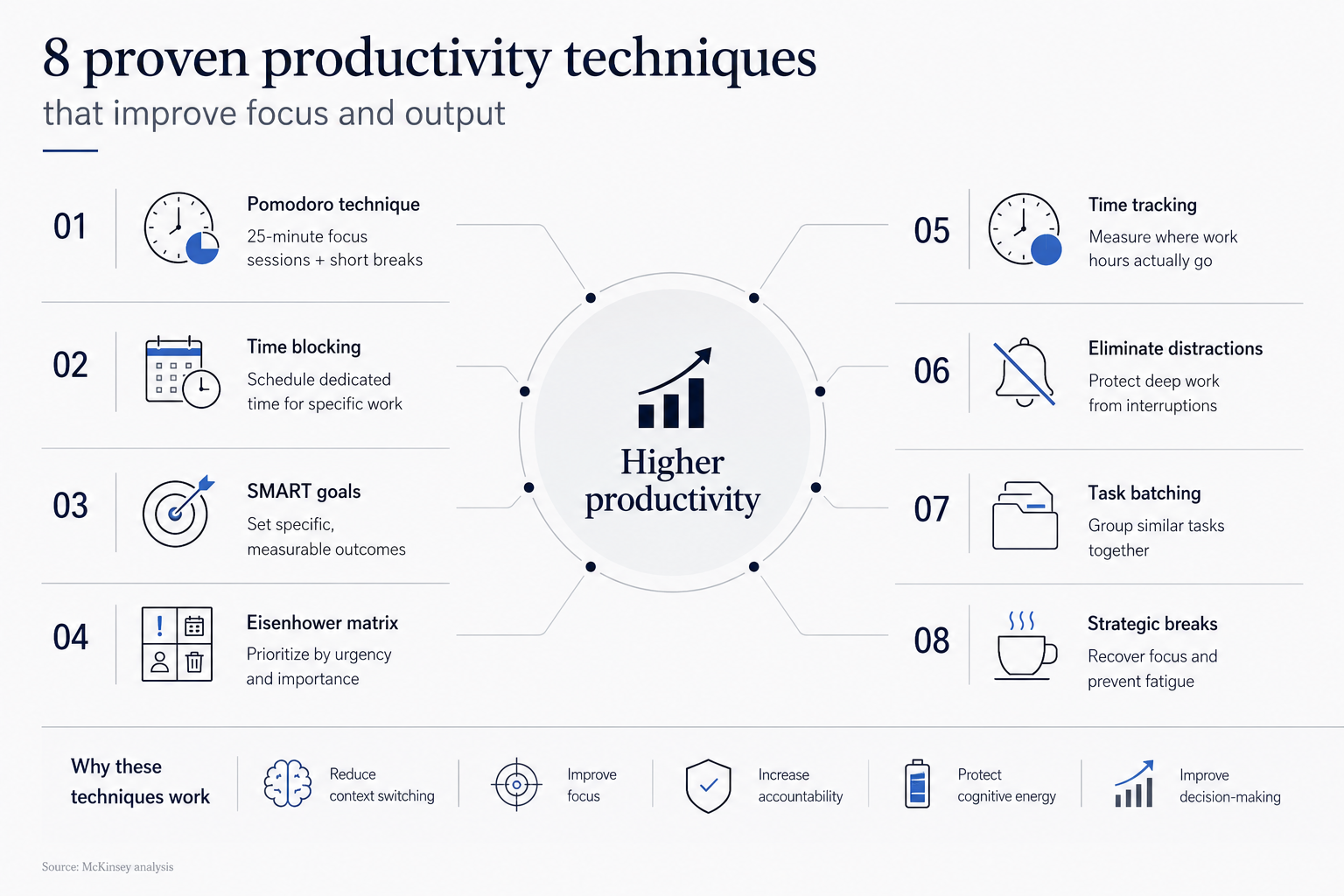
Pomodoro technique: Improve focus and prevent burnout
The Pomodoro Technique breaks work into 25-minute focused intervals followed by a 5-minute break. After four cycles, you take a longer 15–30-minute break to let your concentration recharge. That's the whole system, and it works because it's built around human biology, not willpower.
Research in cognitive psychology confirms that the brain can sustain peak focus for roughly 20–45 minutes before performance starts to dip. The Pomodoro cycle aligns with that window deliberately, preventing the cognitive fatigue that makes the last hour of a long session far less productive than the first. It's particularly effective for analytical work (software development, technical writing, financial modeling) where quality degrades fast when attention wanders.
If you regularly find yourself re-reading the same paragraph or writing code you'll later delete, this is worth trying for a week before dismissing it.
Time blocking: Schedule work for maximum productivity
Time blocking replaces the open-ended to-do list with a calendar that actually reflects how you intend to spend your day. Every task (deep work, email, team check-ins) gets a fixed window. During those windows, multitasking is off the table.
A basic structure might look like this:
[09:00–11:00 Deep Work] → [11:00–12:00 Admin/Email] → [13:00–15:00 Team Collaboration]
This approach eliminates the decision fatigue that builds when you spend the day choosing what to do next. It also creates an honest picture of capacity: when your calendar fills up, you can see immediately that a new request won't fit without dropping something else. That visibility is one of the most practical ways of improving productivity available to managers.
SMART goals: Structured goal-setting for improved productivity
Vague goals produce vague results. The SMART framework (Specific, Measurable, Achievable, Relevant, Time-bound) closes that gap by forcing clarity before work begins.
The difference is concrete. "Increase output" is not actionable. "Publish three technical documentation chapters by Friday at 5:00 PM" is. The second version tells you exactly what done looks like, which means you can assess progress in real time and course-correct early if you're falling behind.
At a team level, SMART goals align daily effort with business objectives. Everyone knows what they're building toward and can prioritize accordingly, which naturally produces improved productivity without requiring micromanagement.
Task prioritization using the Eisenhower Matrix
The Eisenhower Matrix is a four-quadrant prioritization tool that sorts every task by urgency and importance. The result is a clear action for each item: do it now, schedule it, delegate it, or drop it entirely.
The real value of this matrix isn't the quadrants, it's the habit of evaluating tasks before starting them. Most knowledge workers spend time on Quadrant 3 items (urgent but not important) that feel pressing but don't move the needle. The matrix makes that pattern visible. These productivity improvement ideas help managers protect their energy for the work that actually matters.
Time tracking: Identify and eliminate productivity gaps
You can't optimize what you haven't measured. Time tracking gives organizations objective data about where hours are actually going, not where people think they're going.
The gap between those two things is usually significant. Studies show that employees are only productive for around 60% of their working hours, with the rest lost to meetings, context switching, and low-value tasks. Tracking reveals exactly which tasks are eating disproportionate time and where bottlenecks are forming.
At an enterprise level, automated platforms like TMetric provide managers with real-time workload visibility across teams, making it easier to spot resource imbalances and justify staffing decisions with data. It's one of the most direct ways to increase business productivity without adding headcount, because you're solving efficiency problems rather than throwing more people at them.
Eliminate distractions to enhance productivity
Distraction is expensive. UC Irvine researcher Gloria Mark found it takes 23 minutes and 15 seconds to fully recover deep focus after a single interruption. Multiply that by the 6+ interruptions many office workers experience daily, and you're looking at hours of lost productive capacity, every day.
The goal isn't a distraction-free environment (which doesn't exist). The goal is to protect specific windows of uninterrupted work. Practical steps that actually work:
- Turn off non-essential push notifications during deep work blocks.
- Move project status updates out of real-time chat and into tracking software.
- Establish "no-meeting" days to preserve uninterrupted focus time.
- Default to asynchronous communication so responses don't require immediate availability.
These aren't restrictions on how people work, they're infrastructure for enhancing productivity by making it structurally easier to do deep work without constant interruption.
Task batching: Complete similar tasks faster
Task batching groups similar low-intensity tasks (email replies, invoice processing, code reviews) into a single dedicated session rather than scattering them across the day.
The cognitive reason this works: when you perform the same type of action repeatedly, your brain stays in a consistent workflow state. Switching between a strategic document and an email reply forces a mental gear change that costs more time than the email itself. Batching eliminates those gear changes. Two focused 30-minute email windows per day is almost always more efficient than checking messages every 20 minutes, and it frees larger blocks of time for work that actually requires concentration.
This approach is one of the most underused ideas to improve productivity in knowledge work environments, especially for roles that manage high volumes of routine communication.
Take strategic breaks to maintain high productivity
Breaks are not a concession to laziness, they're a cognitive requirement. Sustained work without recovery builds up mental fatigue that quietly degrades decision quality and increases error rates, often without the person noticing.
Neuroscience research confirms that brief breaks allow the brain to consolidate information and reset focus. The Pomodoro Technique builds this in by design; even without that framework, scheduling 10-minute breaks every 90 minutes produces measurably better sustained output than grinding through. Workers who step away from screens during these intervals return with sharper attention, fewer mistakes, and better judgment, which is what productivity enhancement actually looks like in practice.
Best productivity improvement techniques comparison table
Use this reference to match the right framework to your team's role, workflow type, and primary performance challenge.
How to improve productivity in a business: Step-by-step strategy
This five-stage process gives leadership a practical path for improving business productivity, starting from a clean baseline rather than guesswork.
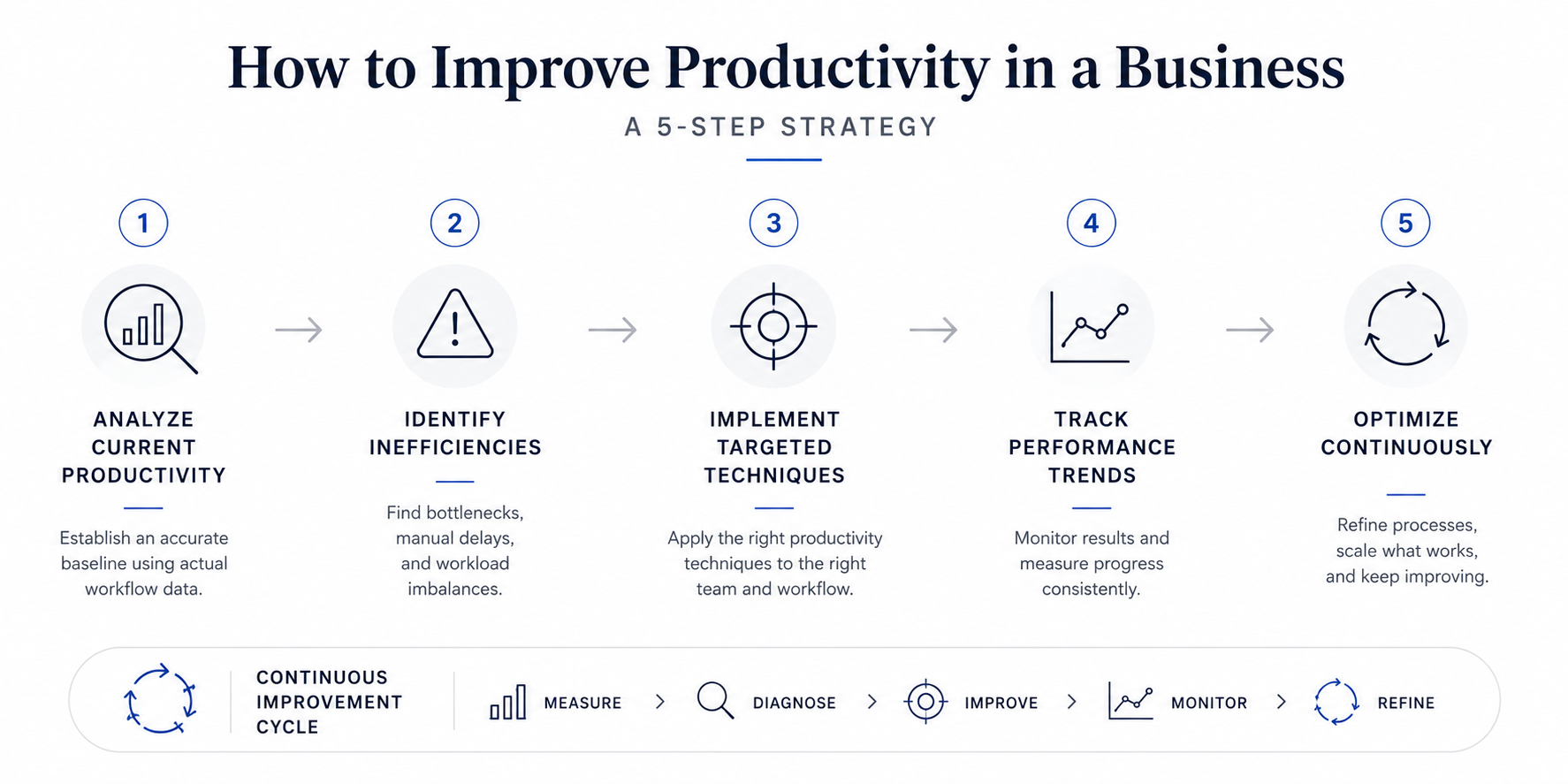
1. Analyze Current Productivity. Establish an accurate baseline by tracking how tasks are actually completed across departments. Avoid relying on self-reported estimates; they're almost always optimistic.
2. Identify Inefficiencies. Audit that data for recurring bottlenecks, manual delays, and workload imbalances. Look for tasks that consistently take longer than expected or require frequent rework.
3. Implement Targeted Techniques. Match frameworks to the type of work. Development teams often benefit most from time blocking. Administrative or comms-heavy roles see faster gains from task batching. One size rarely fits all departments.
4. Track Performance Trends. Use software with a team performance dashboard to monitor whether the new workflows are actually delivering gains. Set short review cycles (monthly is better than quarterly) so you can catch regressions quickly.
5. Optimize Continuously. Treat this as an ongoing operational discipline, not a one-time rollout. Monthly reviews help teams refine approaches, update goals, and scale successful methods across the organization. This is the core of sustainable productivity improvement strategies.
Choosing the best productivity improvement techniques
No single framework works equally well across every role. The key to improving productivity at scale is matching the right method to the right team, then giving people time to adjust before evaluating results.
Creative teams tend to thrive with time blocking because it gives them protected windows for generative thinking. Customer support teams see faster wins from task batching, since their work is inherently interruption-heavy. Technical teams benefit from the Pomodoro Technique or structured deep work blocks, where sustained single-task focus drives quality. Using the same productivity methods across all departments without customization is one of the most common reasons productivity initiatives fail.
The other factor is sequencing. Introducing every framework simultaneously overwhelms teams and creates resistance. A smarter rollout starts with one high-impact change (time tracking is usually the most neutral starting point, since it generates data without dictating behavior) and adds additional frameworks as teams build confidence with the first.
Pairing these frameworks with modern tools helps lock in gains. Platforms like TMetric with a team performance dashboard give managers real-time visibility into workload distribution and project progress, making it far easier to spot when a technique is working and when it needs adjustment. That combination of structured method plus measurement infrastructure is what separates best productivity methods from good intentions.
For ways of improving productivity in a business beyond individual techniques, consider building these habits into onboarding so new team members start with the right workflows from day one. That's how to improve business productivity at the structural level, not just at the individual one.
Key takeaway
The frameworks in this article aren't new, the Pomodoro Technique is 30 years old, and the Eisenhower Matrix predates most modern productivity software by decades. What has changed is the severity of the environment they're designed to counter. The average worker today faces more notifications, more competing priorities, and more meeting overhead than at any point in the past. That context makes structured productivity enhancement less a nice-to-have and more a basic operational requirement.
Your next decision isn't which technique is theoretically best. It's which one you'll actually implement this week. Pick one, apply it consistently for 30 days, then measure whether your output changed. That discipline (choosing, doing, measuring) is what separates organizations that talk about productivity improvement strategies from those that actually see the numbers move.
Frequently asked questions
Quick answers to the most common questions about productivity improvements and how to apply them in real work environments.
What are the best productivity improvement techniques?
The most effective productivity improvement techniques are the Pomodoro Technique, time blocking, SMART goal setting, the Eisenhower Matrix, task batching, and automated time tracking. They work by reducing cognitive friction, protecting focus, and keeping effort directed toward high-value work.
How can businesses increase productivity?
Businesses can increase business productivity by eliminating manual administrative work, establishing clear communication boundaries to protect deep work time, and using workforce analytics software to monitor workload balance across teams. Data-driven decisions consistently outperform intuition-based ones when identifying where time is being lost.
What are the most effective productivity methods?
The most reliable productivity methods focus on managing attention and energy rather than hours on the clock. The Eisenhower Matrix helps teams prioritize work with real business value. Time blocking protects dedicated windows for complex tasks. Both work better in combination than in isolation.
How can I improve productivity at work?
Start with distractions. Turn off non-essential notifications, define your top three priorities each morning using a structured framework, and batch routine communication into two or three daily windows. Strategic breaks are not optional — they're what keeps performance consistent across a full shift. These are practical productivity improvement ideas anyone can implement immediately.
What tools help improve productivity?
Workforce platforms, project management software, and time tracking tools all support enhancing productivity in different ways. TMetric, specifically, gives teams real-time project visibility, tracks time against budgets, and surfaces the data managers need to optimize workload distribution and spot inefficiencies before they become costly.
What is improvement productivity in a business context?
In business, improvement productivity means systematically removing the barriers that slow output — whether that's administrative overhead, unclear priorities, excessive meetings, or poorly distributed workloads. It's a continuous operational discipline, not a one-time initiative.
What are practical ways of improving productivity in a business?
Practical ways of improving productivity in a business include deploying time tracking to establish a data baseline, introducing time blocking for teams with high cognitive workloads, using task batching for administrative roles, and building a structured review cadence to catch what's not working before it compounds. The most important factor is consistency — the techniques have to become habits, not experiments.
How to improve productivity in a business without disrupting teams?
The safest way to approach how to improve productivity in a business without causing friction is to start with measurement. Time tracking generates data without mandating behavioral change, which makes it politically easier to introduce. Once teams can see their own patterns, technique adoption tends to follow naturally.