
How to Avoid Mandatory Overtime: Laws, Rights, and Employer Strategies
Think mandatory overtime is just a quick fix for staffing shortages? Think again. While legally permissible under federal law, chronic overwork triggers an expensive cycle of burnout, absenteeism, and costly turnover.


Mandatory overtime can help cover short-term staffing shortages, but relying on it too often comes at a cost. The World Health Organization estimates that chronic overwork contributes to $322 billion in annual productivity losses worldwide, while 55% of U.S. workers report experiencing burnout.
For employers, the goal is not simply to stay compliant with overtime laws. It is to find sustainable ways to meet demand without creating the turnover, disengagement, and staffing challenges that excessive overtime often causes.
This article explains how mandatory overtime works, employee rights, and strategies employers can use to reduce it.
What is mandatory overtime?
Mandatory overtime is when an employer formally requires staff to work hours beyond their contracted workweek, not as an option, but as a directive.
Is overtime mandatory or voluntary?
That depends entirely on how the employer frames the request. A manager offering extra shifts for additional pay is offering voluntary overtime; a manager assigning those shifts and threatening consequences for refusal is imposing mandatory overtime. Refusing a mandatory shift can result in formal discipline or termination.
The FLSA sets the standard workweek at 40 hours. Any directed time beyond that threshold triggers overtime obligations for non-exempt staff. Organizations typically reach for mandatory scheduling when staffing gaps appear: seasonal peaks, unexpected absences, or demand spikes. Whether that is a reasonable short-term response or a sign of structural understaffing depends on how often it happens.
How it works in practice
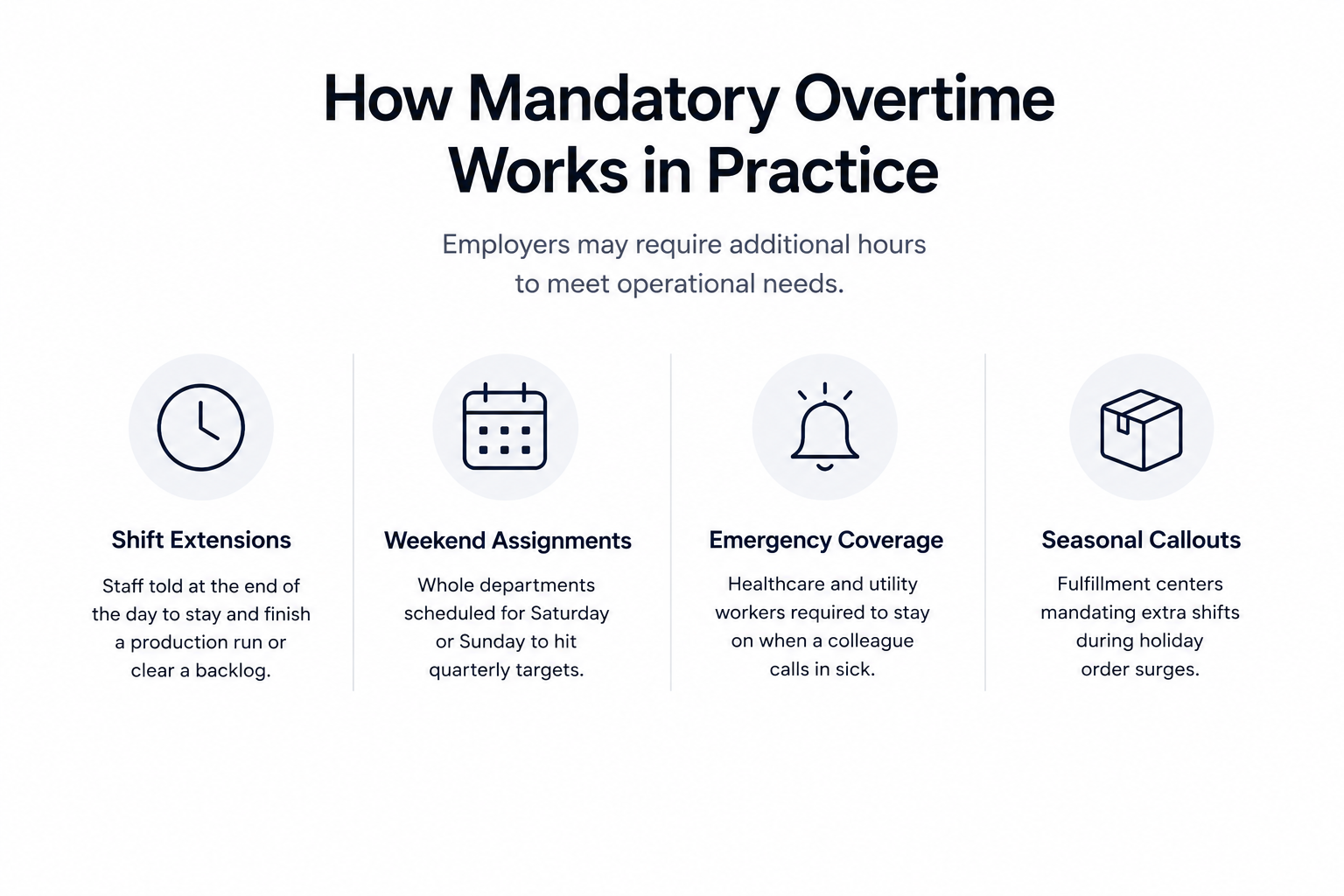
Can a job mandate overtime? Yes, through verbal notice, written directives, or automated schedule updates. In each case the mechanism is the same: the employer exercises its operational authority to set working hours, and the employee is expected to comply. Common forms include:
- Shift extensions: staff told at the end of day to stay and finish a production run or clear a backlog.
- Weekend assignments: whole departments scheduled for Saturday or Sunday to hit quarterly targets.
- Emergency coverage: healthcare and utility workers required to stay on when a colleague calls in sick.
- Seasonal callouts: fulfillment centers mandating extra shifts during holiday order surges.
Is mandatory overtime legal?
Yes, for most adult workers in the U.S. Federal law gives employers broad authority to require extra hours, and no federal statute caps the number of hours an employer can mandate. The legal framework is built around pay requirements, not hour limits.
The federal framework
The FLSA Act requires premium pay for excess hours, it does not prohibit them. Mandatory overtime laws at the state level add some variation: certain states cap daily hours or require specific industry protections, but none eliminate employer scheduling authority outright. If non-exempt employees receive 1.5x their regular rate for every hour above 40, the practice is legal.
Where forced overtime becomes illegal is narrower: failure to pay the required premium, violations of industry-specific safety caps (nursing hours, for example), or disregarding protections under the ADA, FMLA, or a collective bargaining agreement.
Why is mandatory overtime legal?
Federal law generally allows employers to require overtime as part of managing their workforce. Instead of setting a universal limit on overtime hours, lawmakers chose to require premium pay, making excessive overtime more expensive but not prohibited. Some industries face stricter limits for safety reasons, while additional protections may come from state laws, union contracts, or company policies.
Mandatory overtime pay requirements
The FLSA's overtime rules are not complicated, but they are often misapplied. Mandatory overtime pay for non-exempt workers is 1.5 times their regular hourly rate for every hour beyond 40 in a workweek. That premium applies whether the overtime was requested by the employee or assigned by management.
Two common mistakes: offering comp time instead of cash (not permitted for private-sector non-exempt workers), and averaging hours across two pay periods to avoid hitting the 40-hour line (also prohibited). Employers who do either are exposed to back pay claims and Department of Labor penalties.
How much mandatory overtime is legal?
Federally, there is no ceiling. How much mandatory overtime is legal under the FLSA is effectively unlimited (50, 60, 80 hours a week) as long as the premium pay rule is followed. The exceptions apply where public safety is at stake. The FMCSA limits truck drivers to 11 driving hours after 10 consecutive hours off duty. Most states have passed healthcare laws capping mandatory nursing hours. Outside those sectors, the only real check is financial: overtime is expensive, and most employers have a practical limit even without a statutory one.
How much notice is required for mandatory overtime?
Federally, none. A manager can inform an employee at the end of a shift that they are required to stay. However, Fair Workweek laws in Oregon, Chicago, and New York City change that for covered retail, fast-food, and hospitality employers. Schedules must be posted at least 14 days out, and adding mandatory hours within that window triggers predictability pay penalties of one to four hours' wages. Outside those jurisdictions, advance notice is a courtesy, not a legal requirement.
Can an employer make overtime mandatory?
Yes. Under federal law, employers can generally require employees to work overtime and make it a condition of employment. In most circumstances, refusing mandatory overtime can result in disciplinary action or termination, provided the employer complies with applicable wage and hour laws.
The general rule
Can a job make you work mandatory overtime? For non-exempt and most exempt employees, yes. Refusal is treated as insubordination in at-will states, and an employer can terminate for it. The employee's options are limited unless a recognized legal exemption applies.
Legal exceptions
Four protections can override an employer's scheduling authority:
- ADA accommodations: an employee with a documented disability can request a capped workweek as a reasonable accommodation.
- Religious observance: Title VII requires employers to accommodate sincerely held religious beliefs around scheduling, unless doing so creates undue hardship.
- Union contracts: collective bargaining agreements frequently limit mandatory hours or establish seniority-based assignment rules.
- FMLA leave: employees using approved intermittent FMLA leave cannot be forced into overtime hours during that leave.
The problem with too much mandatory overtime
Too much mandatory overtime does not just cost more in wages, it degrades the workforce it depends on. A 2024 study in the American Journal of Preventive Medicine found burnout costs $3,999 per year per hourly employee and $10,824 per manager, before overtime pay is factored in. Burned-out employees are 63% more likely to call in sick, which creates the staffing shortage that triggered the overtime in the first place.
The warning signs of over-reliance are consistent across industries: error rates climb, absenteeism rises, and high performers, who have options, start leaving. Safety incidents often increase too, particularly in physical roles where fatigue is a direct risk factor. At that point, the overtime is not solving an operational problem. It is masking one, and each week it continues makes the underlying problem harder to fix.
Proven strategies for reducing mandatory overtime
Chronic mandatory overtime is a planning failure, not a staffing shortfall. The fix is structural. Each of the five strategies below addresses a different root cause — from upstream forecasting to day-to-day scheduling visibility. Most organizations need more than one. The table below covers what each intervention involves and what it actually changes.
| Strategy | What to do | How it reduces overtime | Business impact |
|---|---|---|---|
| Improve workforce planning |
Hire against workload forecasts, not headcount targets. Audit staffing gaps every quarter. | Eliminates the chronic understaffing that makes overtime the default response. | Predictable labor costs, fewer emergency callouts, lower burnout risk. |
| Real-time time tracking |
Deploy time tracking software with automated 40-hour threshold alerts. | Managers see overtime building before it lands — not after the week closes. | Accurate payroll, early intervention, data to justify permanent headcount changes. |
| Predictable scheduling |
Publish shifts at least two weeks out. Rotate heavy workloads across the team. | No last-minute surprises. Employees can flag conflicts before they become gaps. | Lower turnover, better morale, more stable operations. |
| Automate repetitive work |
Map high-volume manual tasks. Apply workflow automation where the ROI is clear. | Shrinks the workload that overtime was covering in the first place. | Higher throughput without adding hours or headcount. |
| Cross-train for coverage |
Train staff in at least one adjacent role. Document backup coverage for every key position. | One absence no longer triggers a cascade of forced extra hours. | Resilient scheduling, reduced dependency on single specialists. |
How time tracking software helps
Manual timesheets show you what happened last week. Time tracking software shows you what is about to happen. That difference matters when the goal is to intervene before overtime accumulates rather than reconcile it after.
Set up correctly, a platform like TMetric sends automated alerts when any employee approaches the 40-hour mark. This gives managers a window to redistribute tasks, bring in part-time coverage, or defer non-urgent work. The same data, aggregated over months, surfaces patterns that are hard to see week to week.
This includes indication of which roles are chronically short-staffed, which teams absorb overtime disproportionately, and which managers consistently rely on forced scheduling as a first resort rather than a last one. That is the evidence that justifies a permanent hire, a workflow change, or a scheduling redesign, rather than another week of the same workaround.
Takeaway: Preventing mandatory overtime requires planning and visibility
Mandatory overtime is legal, and sometimes it is the right call. A one-off production emergency or an unexpected absence is exactly what it is designed for. The problem is when it becomes the default. Burned-out employees are 63% more likely to take a sick day and significantly more likely to quit, which means chronic overtime tends to make the staffing problem worse, not better.
Reducing that dependency takes accurate demand forecasting, schedules that distribute workload fairly, and real-time visibility into hours before the week closes. The tools exist. The harder part is cultural: organizations that treat overtime as a reliable lever rather than an occasional necessity tend to normalize the very conditions that make reducing it feel impossible. Breaking that cycle starts with deciding to measure it.
Frequently Asked Questions
Is mandatory overtime legal?
Yes, under federal law. The FLSA does not cap mandatory hours, it requires premium pay (1.5x regular rate) for all non-exempt hours above 40 per week. State laws and industry regulations add specific limits in certain sectors.
Can a company make you work overtime?
Yes. Refusing a mandatory shift is grounds for discipline or termination in at-will states, unless the employee is protected by an ADA accommodation, an FMLA designation, a religious observance claim, or a union contract.
How much notice is required for mandatory overtime?
None under federal law. Fair Workweek rules in select cities require 14 days' advance notice for hourly workers in retail, hospitality, and fast food, with penalty pay for last-minute changes.
Can you refuse mandatory overtime?
You can refuse, but without a recognized legal exemption, the employer can legally terminate the employment. ADA accommodations, FMLA leave, collective bargaining protections, and documented religious conflicts are the main avenues employees use to limit forced scheduling. Each has specific documentation requirements, so the exemption needs to be established before the conflict arises, not after.
Should mandatory overtime be illegal?
It is a contested question. Labor advocates argue the current framework (premium pay as a deterrent rather than a hard cap) is insufficient to protect worker health. The legal system has responded with targeted restrictions in high-risk industries but has not moved toward a universal limit. Union contracts and state predictive scheduling laws currently provide the most meaningful protections beyond what federal law requires.